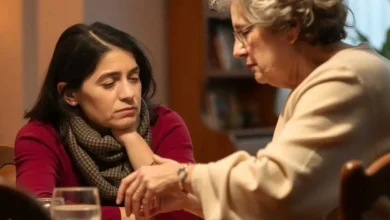
The Millionaire Fired 15 Nannies in 2 Months — Until a Cleaner Changed Everything

When the fifteenth nanny ran down the mansion’s main hallway with smeared makeup, her uniform stained with red paint, and terror in her eyes, David Morrison finally admitted what he had been refusing to face for months: he had completely lost control of his own home.
The door slammed behind her. The echo climbed the high walls, passed the family portraits, and died into a silence heavier than any scream. It was the kind of silence filled with guilt.
David was thirty-six, the founder of a tech company worth hundreds of millions of dollars—one of those men who appeared on business magazine covers and spoke about leadership in packed auditoriums. He could negotiate with investors who never smiled and talk about seven-figure numbers without his voice shaking.
Yet the sound of his youngest daughter crying was enough to squeeze his chest until he could barely breathe.
It hadn’t always been like this.
Everything had fallen apart a year and three months earlier, when Sara, his wife, lost her battle with cancer. With her, David didn’t just lose the love of his life—he lost the heart of the house. Sara was the only one who could turn a tantrum into laughter, a nightmare into a lullaby, and a chaotic day into something worth remembering.
After she died, each child found a different way to scream without words.
Emma, the youngest, four years old, stopped speaking in complete sentences after the funeral. When she did speak, it was in whispers to headless dolls. The twins, Marcus and Michael, seven, turned every meal into a war: flying plates, spilled juice, endless yelling. Sofía, nine, woke up at night calling for her mother, drenched in sweat. And Alexander, eleven, built a wall of ice. He looked at his father with a silent reproach that made David feel guilty for simply existing.
Fifteen nannies. Fifteen “perfect” professionals—certifications, languages, experience with “high-profile families.” Some lasted days. Others, hours. The last one barely survived until lunchtime.
None of them understood the problem wasn’t a lack of discipline.
It was the absence of a mother.
That night, in his glass office in San Francisco with the city glittering below, David listened as the director of the most exclusive nanny agency in California spoke in a tone so polite it sounded cruel:
“I’m sorry, Mr. Morrison… we’ve done everything we can. But your children have very complex emotional needs. Our nannies are not trained to handle that level of trauma.”
“Complex needs.”
As if grief could fit into a spreadsheet. As if someone with a perfect smile and strict rules could repair broken hearts.
David returned to his home in Palo Alto even later than usual. The eight-bedroom mansion that once echoed with laughter and smelled of fresh cookies now felt like a museum. Toys scattered across the floor didn’t speak of play anymore—they spoke of neglect. Soft lighting didn’t create warmth; it created shadows.
He climbed the marble staircase Sara had chosen with such joy. He passed the framed photos without looking at them. He stopped at the bedroom they had shared and opened the door slowly.
Everything was frozen in time: her book open, her shoes lined up, a scarf on the chair, her perfume still in the air like a kind ghost.
David sat on the bed and, for the first time since Sara’s death, he cried without trying to be strong. He cried for her, for his children, for all the times he had pretended to be fine while signing contracts as he collapsed inside. He had money, influence, success… and he couldn’t get the one thing that truly mattered: someone who could hold his children the way a mother would.
That night, between rain tapping on the window and the sound of his own sobbing, a decision formed inside him.
The next morning, David stopped looking for “perfect nannies.” He wanted something else: someone who understood that tantrums aren’t always bad behavior—sometimes they’re a cry for help. Someone who could recognize pain and not run from it.
He didn’t know the right person was already, unknowingly, very close to his world.
Across the city, María Guadalupe Hernández pushed her cleaning cart into a cold basement storage room in a high-rise. She was twenty-five and doing three things at once: in the morning, she studied child psychology at a community college; in the afternoon, she watched a neighbor’s kids; at night, she cleaned offices where the names on the doors moved millions.
María didn’t work like that only out of necessity. Every dollar was a step toward her dream: becoming a grief-focused child therapist.
At sixteen, she lost her little brother Diego in a car accident. He was eight. Since then, she had never forgotten the empty look in the eyes of children who suffer—how alone they can feel even surrounded by well-meaning adults who don’t know what to say.
That night, on the 32nd floor, while doing her routine—polishing glass, emptying trash cans, cleaning up after important meetings—something yellow taped to the window of an office with a breathtaking view caught her attention.
It wasn’t a corporate announcement.
It was a simple sheet of paper, handwritten, the letters cramped as if the writer had been rushed or afraid.
“I’m looking for someone who understands my children don’t need more discipline. They need love. Who knows their outbursts aren’t rudeness—they’re pain. I don’t need perfect references. I need a heart that won’t quit.”
María read it once. Then again. And again.
A knot formed in her throat.
She could picture those children. She could almost feel them—like she was sitting on the floor among broken toys. Because deep down, she had once been someone who only needed to hear: “You’re not crazy. You’re grieving.”
At the bottom was an address in Palo Alto and an email.
Palo Alto. Iron gates. Perfect lawns. Mansions she’d only seen in magazines.
A frightened voice inside whispered, “That’s not for you.”
But the note wouldn’t leave her mind.
At two in the morning, in the small apartment she shared with two roommates, she turned on an old laptop and opened her email. Her hands trembled as she typed.
She didn’t talk about fancy degrees. She talked about Diego. About what grief does to a family. About how children don’t need to be told to “be strong”—they need someone to sit on the floor beside them and survive their tears without getting scared.
When she finished, the cursor blinked over “Send” like a challenge.
María took a deep breath and pressed it.
At the same time, David was ignoring messages from agencies promising “structure,” “control,” “routine.” Everything sounded cold.
Until one subject line stopped him: “About your children.”
No logo. No empty promises.
He opened it. He read.
And for the first time in a long time, a word that had almost disappeared from his vocabulary returned—quietly:
hope.
At eight a.m., María’s phone vibrated as she waited for the bus.
“María Hernández?” a tired but gentle voice asked. “This is David Morrison. I read your email. Can you come to my house today?”
When the bus dropped her in Palo Alto, María felt like she had stepped onto another planet. Houses weren’t houses—they were estates. Iron gates, marble fountains, circular driveways.
For a moment, she almost turned back.
But she remembered the note: “a heart that won’t quit.”
She rang the bell.
No perfect butler opened the door. No assistant in a blazer.
A man with unshaved stubble, deep dark circles under his eyes, and a wrinkled shirt stood there.
He didn’t look like the polished billionaire in magazines.
He looked like an exhausted widower.
“Thank you for coming,” he said, and his sincerity was fragile.
Inside, the house smelled like something María recognized immediately: old, settled sadness.
In the kitchen, five breakfast plates sat untouched.
“Every morning is like this,” David admitted, struggling to keep his voice steady. “Emma barely eats. The twins destroy everything. Sofía cries if the food isn’t like her mother’s. Alexander… Alexander barely talks to me.”
María didn’t lecture. She didn’t recite techniques. She simply listened.
And in that quiet, steady listening, David felt something he hadn’t felt in months: that someone could see his pain without judging him.
“May I meet them?” María asked.
They went upstairs. The sounds of chaos met them—slamming doors, crashing objects, a TV turned up too loud.
Emma sat on the floor surrounded by headless dolls. Tangled hair. Puffy eyes from crying.
David began to explain, but María crouched down and did something unexpected: she picked up a broken doll, smoothed its dress, stroked its plastic hair, and stayed there at the child’s level without trying to “fix” the damage.
Emma stared, curious.
No one had reacted like that before.
A loud crash came from the hallway. The twins.
Their room looked like a battlefield. They shoved each other with rage far too big for seven-year-olds.
María sat on the floor, crossed her legs, and waited.
At first, they ignored her. Then they noticed she wasn’t yelling, threatening, or panicking.
The rage began to fade.
“Why aren’t you scolding us?” Marcus snapped, fists still clenched.
“Because I don’t think you’re really fighting each other,” María said softly. “I think you’re fighting something you can’t see. Someone… you miss too much.”
Michael crumpled.
“Mom said she’d never leave… and she did.”
María moved closer, slowly.
“Sometimes people have to leave even if they don’t want to,” she whispered. “But that doesn’t mean they stopped loving you. It only means they love you from somewhere else now.”
The boys leaned into her like lost puppies.
At the doorway, David wiped a tear on his sleeve.
Sofía was in the laundry room, trying to fold a shirt for the fourth time.
“It never looks the same like when Mom did it,” she cried. “If I don’t do it, no one will. I have to take care of everyone.”
María knelt beside her.
“No, sweetheart. Your job is not to take care of everyone. Your job is to be a child who misses her mom,” she said, holding her hands. “The food, the laundry, the bills—that’s for adults. You don’t have to be perfect for your dad to be proud of you.”
Sofía collapsed into her arms.
Alexander’s door was locked. Music blared from inside.
María didn’t knock. She sat in the hallway and waited.
Minutes passed. The music changed, then stopped. Finally, the door opened just a crack.
“If you came to tell me to behave, don’t waste your time,” Alexander said, hard.
“I didn’t come for that,” María replied. “I came to tell you I know what it feels like when your world breaks and everyone expects you to act like nothing happened.”
Alexander narrowed his eyes.
“You lost your mom?” he asked sharply.
“I lost my little brother,” María said plainly. “And I thought the pain would stay forever.”
“Does it go away?” he whispered.
“It changes,” she said. “It stops being an open wound and becomes love with nowhere to go. And if you find somewhere to put that love… it can become something beautiful.”
Alexander didn’t open the door fully—but he didn’t close it either.
In that house, that was already a miracle.
The following days weren’t magical or perfect. There were still screams, broken plates, nightmares.
But something had shifted.
Emma started eating small bites when María cut fruit into butterfly shapes. The twins still argued, but now they sought María before hitting each other. Sofía returned to playing. Alexander stayed distant, but sometimes listened from the stairs while María read to the little ones.
David watched from a careful distance, as if afraid a sudden movement would break the spell.
Then came the test.
David’s sister, Margaret, arrived unannounced—pearls, designer bag, and a voice full of certainty.
In the office, she didn’t waste time.
“That girl is not suitable,” she said. “She isn’t from our world. You need someone appropriate.”
Something flared inside David.
“The only thing my children need,” he said through clenched teeth, “is someone who truly loves them. And that is exactly what she does.”
The argument grew ugly. Margaret spoke of reputation and status. David spoke of Emma eating without tears, the twins without bruises, Sofía dancing again, Alexander lowering his guard.
Later, Alexander found María in the kitchen, her eyes distant.
“Are you going to leave?” he asked.
María took a breath.
“Your aunt is right about one thing,” she admitted. “I don’t come from your world.”
Alexander’s answer cut straight through her fear.
“So what?” he said. “What matters is you stayed. You brought us back.”
Then he begged in the simplest way:
“Then don’t go. Don’t leave us like Mom did.”
That plea decided something inside María.
The next day Margaret returned with a spotless agency director and a folder of “ideal candidates.”
But when they reached the backyard, they froze.
On an old blanket in the grass, María was handing out star-shaped sandwiches. Emma laughed in her lap. The twins built a fortress out of cardboard boxes. Sofía danced with her dolls. And Alexander helped pour lemonade—smiling, just a little.
Emma saw her father and ran to him.
“Dad, come! María says if you eat a star you can make a wish!”
David looked at his children—alive, present, laughing.
He looked at María, hair tousled by the wind, eyes bright, surrounded by five children who no longer looked like ghosts.
And he decided.
“Thank you for coming,” he told the agency director, “but we don’t need anyone else.”
It seemed like the story had found balance.
But real love is always tested.
Three weeks later, Sofía’s scream tore through the night:
“Dad! María! Emma!”
Emma was on the bathroom floor, burning with fever, her body convulsing. The twins cried in terror. Sofía trembled, repeating “It’s okay, it’s okay.” Alexander held the phone to his ear, speaking to emergency services with a calm no eleven-year-old should have.
In the middle of it all, María cradled Emma, pressed cold cloths to her forehead, and murmured gentle words in Spanish and English—as if weaving a blanket of calm with her voice.
David tasted panic like metal.
The same panic from the day he lost Sara.
“Not again.”
María looked him in the eyes.
“Breathe, David. She needs you whole.”
At the hospital, the hours stretched into eternity. When the doctor finally came out, everyone held their breath.
“Pneumonia,” he said. “But you brought her in time. With antibiotics and rest, she’ll be fine.”
Relief hit so hard David had to sit down.
On the way home, with Emma asleep, Alexander spoke from the back seat:
“Dad… when Emma got like that, the only thing I wanted was for María to be there.”
David met his eyes in the rearview mirror.
“Why?” he asked.
“Because she truly loves us,” Alexander answered without hesitation. “Like Mom.”
That sentence unlocked something David had kept shut out of fear of betraying Sara’s memory.
That night, María was still awake in the kitchen making soup. Exhausted, hair messy, hands red from washing.
She still smiled automatically when David walked in.
“Thank you for everything today,” he began.
“Anyone would’ve done it,” she tried to shrug it off.
“No,” David said. “Not anyone. You did what a mother would do.”
María froze.
“David… don’t say that if you don’t…”
“I love you,” he cut in.
The words hung in the air—heavy, irreversible.
“I love how you look at my children,” he went on. “I love how you brought this house back to life. I love how you taught me I can remember Sara without breaking. I don’t want to imagine this home without you.”
María closed her eyes for a second. She thought of judgment, of worlds, of not fitting in.
David took her hands.
“If people don’t understand… that’s their problem. I’m not losing you because of it.”
María breathed in and answered with tears in her eyes:
“I love you too.”
From the top of the stairs, Alexander—who had come down for water—saw them embrace. For the first time, he smiled without guilt. He went back to his room with a lighter heart.
A year later, the mansion no longer felt like a museum.
It felt like home.
Emma ran through the garden chasing butterflies, laughing—“Look, Mommy María!” The twins poured their energy into building and inventing instead of breaking. Sofía imagined futures again. Alexander returned to the piano, teaching Emma little melodies before bed.
David was still wealthy and successful, but he traded late-night meetings for family dinners, numbers on screens for drawings on the fridge. He learned that real success was watching his children fall asleep feeling safe.
María graduated with honors and began a master’s program in child therapy. She no longer cleaned offices at night. She used her story to help other grieving children.
Their wedding was in the garden—simple, beautiful, only the people who mattered. María’s family traveled from Mexico. Close friends came. Even Margaret attended. It took months, but seeing her nephews and nieces come back to life broke down her prejudice.
On the day, Margaret hugged María and whispered:
“Thank you for giving us David back… and these children.”
Months later, Emma ran in holding a wrinkled drawing.
“Mommy María, look! I drew our family!”
Seven figures holding hands. And above them, in a blue sky, a woman with wings watched from a cloud.
“And who is she?” María asked, pointing.
Emma answered solemnly, like it was obvious:
“That’s my first mommy, Sara. Dad says she sent you when she couldn’t take care of us anymore… so we wouldn’t be alone.”
María felt her chest break and rebuild at once. She hugged Emma, smelling soap and crayons.
In that moment, she understood completely:
She hadn’t come to replace.
She had come to add.
Because real love doesn’t shrink when it’s shared.
It multiplies.
And that’s how a handwritten yellow note—and the courage of a woman who refused to give up—turned a house of silence into a house of life.