The Master Key
I had never truly felt cold…
until the December wind struck my face and I had no door to close it out.
It wasn’t ordinary cold.
It was the kind that crawls into your bones, tightens your chest, and makes you wonder if you’re still alive.
My name is Harper Martínez.
I was ten years old, and to most people in New York, I was just that: another lost child, dirty, invisible, a “hopeless case.”
My parents had disappeared so long ago that I no longer knew how to explain whether they had left on their own or whether the system had swallowed them first. All that remained were blurred memories, faint smells, and a constant feeling of abandonment.
The foster system tried to “fix” me three times.
Three homes.
Three hells.
In the last one, the foster father locked me in the basement because he said my eyes “judged” him.
So I ran away.
I chose the risk of freezing to death in Central Park over dying of sadness in a basement in Queens.
On the streets, I learned things no child should ever have to learn.
I learned how to become invisible.
I learned that people don’t really see dirty little girls—their eyes simply slide past you, as if you’re part of the pavement.
And I learned how to survive.
While other kids cried, I observed.
While others begged for coins, I searched for cables.
Because I had a gift.
I don’t know where it came from. Maybe it was the only real inheritance my parents left me.
I understood machines.
To me, a computer wasn’t a magic box. It was a logical puzzle.
I taught myself to read at four years old.
At seven, I disassembled and rebuilt my first smartphone, one I found in the trash near Wall Street. The screen was shattered, but the processor still worked. I connected it to an old battery and made it power on.
My first victory.
Public libraries became my refuge. Not just because of the heat—which felt like a miracle—but because of the Wi-Fi, the books, and the silence.
Sometimes librarians kicked me out because of the smell.
I always came back.
I read everything I could find about programming, cybersecurity, encryption, networks, protocols. It was ironic: a girl with no house key learning how to create the most complex digital keys in the world.
The Day I Met the Man of the Empire
That day, hunger hurt like a physical cramp in my stomach.
I hadn’t eaten real food in two days. Only water from public fountains.
I was walking near 42nd Street, my torn sneakers letting slushy snow seep in. My body was shaking. My brain—normally sharp—felt slow, like a computer with too many tabs open.
I needed fuel.
I looked up and saw the Chrysler Building cutting into the winter sky.
To tourists, a monument.
To me, an opportunity.
I had heard rumors among veteran homeless people: executive floors throw away full banquets. Real food. Sushi barely touched. Steaks. Desserts untouched.
But getting in wasn’t easy.
Cameras.
Guards.
Sensors.
Still, security always has one flaw: the human factor.
No one suspects a small child.
I waited in the loading alley until a laundry truck pulled out. The guards were joking with the driver. In that split second of distraction, I slipped behind some containers and went inside.
The warmth hit me like a hug.
It smelled clean. Expensive. Like a life I didn’t have.
I moved fast, hugging the walls, climbing the service stairs.
Floor 20…
Floor 40…
Floor 60…
The higher I went, the quieter it became.
The carpet swallowed my footsteps.
I was searching for a break room, a kitchen—anything.
Then I heard voices.
Panicked voices.
“It’s impossible!”
“The firewall keeps rejecting us!”
“Try again! We’ve got twenty minutes!”
Curiosity defeated hunger.
I approached.
The door was slightly open.
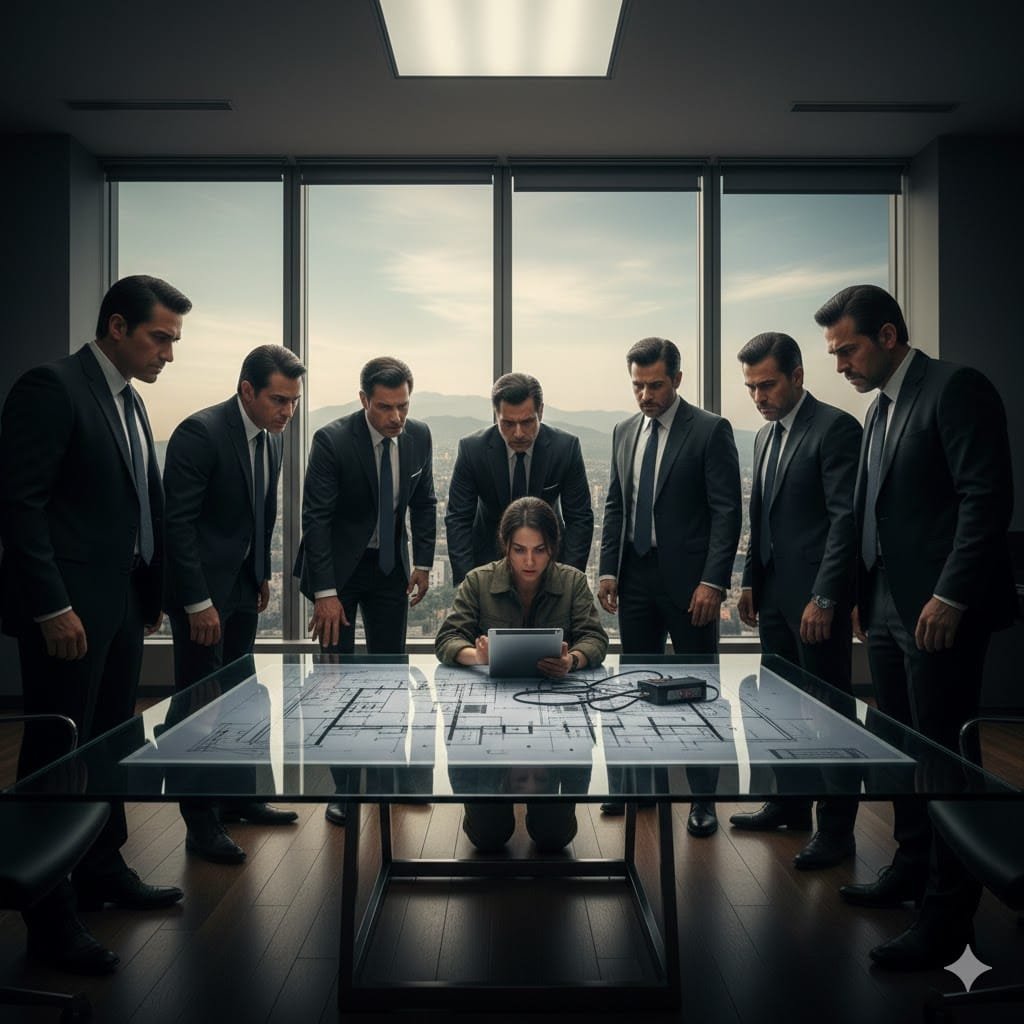
Inside was a room that screamed money: massive office, panoramic city views, polished wood furniture. Six men in suits worth more than I would ever own in my lifetime were gathered around a high-tech safe embedded in the wall.
It wasn’t an ordinary safe.
It was a digital fortress.
I recognized it instantly: Titanium-X 9000. Biometrics, voice recognition, advanced encryption, remote synchronization.
A beast.
And the “experts” were failing.
Among them stood a man I recognized from discarded newspapers in the subway:
Fared Alzahara.
Arab billionaire. Oil tycoon. Owner of half of Manhattan—at least according to the headlines.
He was shouting, furious:
“If I don’t get those contracts out now, the merger collapses! I lose billions!”
The technicians were sweating, typing, retrying.
And with every attempt, they made it worse.
I saw the mistake immediately.
They were treating it like a password-lock system.
But the Titanium-X didn’t lock due to wrong passwords.
It locked due to latency desynchronization.
They were flooding the system before the security handshake with the Swiss server could complete.
My stomach growled.
Loud.
Everyone turned.
They saw me.
A small Latina girl, wearing clothes three sizes too big, looking like she hadn’t slept in days.
Fared blinked.
“How did this child get in here?”
No one answered.
I stepped forward.
I wasn’t afraid.
After sleeping under bridges with rats, an angry billionaire didn’t scare me.
“You’re failing because of latency,” I said.
Fared froze.
“What did you say?”
“Your safe won’t open because your experts are impatient. You need to wait between biometric validation and the numeric code. Four and a half seconds. If not, it locks permanently.”
Silence.
A technician scoffed.
“And how would a filthy kid like you know that?”
“Let her speak,” Fared said.
He looked at me with new intensity.
“Can you open it?”
I took a breath.
“I can stop you from locking it forever. You’re seconds away from destroying everything.”
Then I said the truest thing in that room:
“And I’m hungry.”
Fared laughed dryly.
“Fine. Let’s make this interesting. If you open it in ten minutes… I’ll give you one hundred million dollars.”
The men laughed.
I understood immediately.
A cruel joke.
A billionaire entertaining himself with a street kid’s misery.
I didn’t react.
I only asked:
“And if I can’t?”
“I call the police. Trespassing.”
I looked at the safe.
The clock.
Then at him.
“First, I want a sandwich.”
He raised an eyebrow.
“What kind?”
“Turkey. Lots of cheese.”
He nodded.
“Deal.”
The Dirty Girl and the Impossible Safe
I sat in the massive leather chair, my feet barely reaching the floor.
The sandwich arrived.
I devoured it in seconds.
Fuel.
“Five minutes,” Fared warned.
The tension was suffocating.
I placed my fingers on the panel.
The screen glowed blue: SYSTEM LOCKED — WAITING FOR CYCLE.
“Everyone stay quiet,” I ordered.
A technician protested.
“Quiet,” Fared snapped.
I rebooted the panel.
Biometrics.
“Your hand,” I told Fared.
He placed his palm.
Beep.
Accepted.
Now the timing.
I counted internally.
One…
Two…
Three…
Four…
Four and a half.
My fingers flew.
The safe emitted a sound no one had heard all morning—a deep hum, like a relieved sigh.
The internal mechanisms rotated.
Click.
Click.
Click.
The red light hesitated.
Then turned green.
ACCESS GRANTED.
The heavy steel door slowly opened.
I spun the chair.
“It’s open.”
No one spoke.
Fared rushed forward, grabbed the contracts, verified them.
His empire was saved.
He looked at me.
No mockery.
Only respect.
And fear.
“You did it…” he whispered.
“It was latency,” I shrugged.
The Promise That Became Law
Reality returned.
Someone laughed nervously.
“Hundred million? Good joke.”
I stood up.
I knew the world.
Rich people don’t give money to street kids.
I had gotten my sandwich.
That was more than expected.
“Thanks for the food,” I said, walking away.
My dignity was all I had.
“Wait,” Fared said.
I stopped.
“Where are you going?”
“Back to the street. Home.”
“You’re giving up your prize?”
I turned slowly.
“You made a joke. I was hungry. You saved your business, I filled my stomach. A hundred million doesn’t fit in my torn pockets.”
Fared knelt to my level.
“In my culture—and in real business—your word is law. If I break my word to you, I break my honor.”
He called his lawyers.
“Bring my legal team. A bank manager. A notary. Now.”
Then he smiled.
“I’m not giving you cash. We’ll create a trust fund. Today, Harper Martínez stops being invisible.”
I didn’t cry.
But for the first time in months, the cold inside me began to melt.
The System Strikes Back
Lawyers arrived like sharks.
Then CPS showed up.
They wanted me.
They wanted the money.
I panicked—until I remembered who I was.
I pulled out my phone.
Public records. Dates. Evidence.
I exposed the social worker’s corruption on the spot.
She fled.
I had won.
Fared sat beside me.
“You’re dangerous, Harper.”
“I just defend myself.”
“You won’t do it alone anymore,” he said. “I’ve filed for adoption.”
I stared at him.
“Why?”
He smiled.
“You reminded me why I work. And I need someone to fix my computers.”
I smiled back.
“Deal. But I have conditions.”
“Which?”
“I want real school. I want to learn everything.”
“Done.”
Family, Finally
Two years later, I was twelve.
No longer invisible.
I created Project Phoenix.
We searched for forgotten children with brilliant minds.
We found them.
We rescued them.
One winter evening in the Bronx subway, I met Mateo.
A boy hacking electricity to power a laptop.
I offered him a sandwich.
Then a choice.
“Want to stay here in the dark… or come with me and learn to hack satellites?”
He took my hand.
That was the real prize.
I was once invisible.
Now I was the master key.
And if the system forgot you…
Maybe we’re already looking for you.
Are you ready to open your own safe?