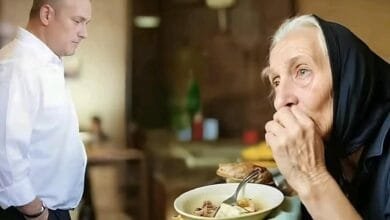
Sons Throw Their 70-Year-Old Mother Out in the Rain… and Fate Teaches Them a Lesson

It was a cold night in November. The city seemed to shrink under the storm: rain hammered the asphalt, puddles spread across every corner, and the wind whipped through the trees as if trying to tear away the last leaves of autumn.
In the middle of that downpour, a 70-year-old woman walked slowly along the sidewalk, drenched from head to toe. Her name was Rosa. Her hands—worn by time—trembled as she clutched an old suitcase, the kind that had seen better days. Her white hair stuck to her face, and her tears blended with the rain.
Rosa wasn’t out there by accident.
Minutes earlier, her own children had thrown her out of the house where she had lived for more than forty years—the house she had built beside her husband, Fernando, the love of her life. It was there that she raised three children with sacrifice, absolute dedication, and a love that never seemed to run out: Carlos, the oldest, 38; Laura, 35; and Miguel, the youngest, 32.
Fernando had died five years earlier. Rosa was shattered, but she held on to the promise her children made:
“You’ll never be alone, Mom. We’ll take care of you.”
In the beginning, despite the grief, she lived on a modest pension and a few savings she had carefully set aside. Her children visited… but less and less. Carlos was always busy with work. Laura was swallowed by her own family routine. Miguel disappeared behind excuses and silence.
Rosa tried not to feel resentful. She told herself that’s just how adulthood is, that life consumes people. But at night, inside that big empty house, loneliness spoke louder than any explanation.
The Fall That Became an Excuse
Six months before that stormy night, everything got worse.
Rosa fell at home and fractured her hip. The surgery was expensive and drained nearly all her savings. For the first time in a long while, she had to ask her children for help—money, care, presence.
Carlos lent her part of it, but never missed a chance to remind her:
“Don’t forget this was my money.”
Laura took care of her for two weeks. Then, exhausted and irritated, she said she couldn’t “put her own life on hold” for her mother. Miguel… didn’t even answer the calls.
When Rosa started walking again—still with difficulty and leaning on a cane—she believed the worst was over. She only wanted peace. She only wanted her home.
But her children had other plans.
One day, all three showed up together—something that hadn’t happened in years. Rosa’s heart lifted, thinking maybe they were there to have dinner like in the old days, to talk, to laugh… But their faces didn’t carry longing. They carried a decision.
Carlos went straight to the point:
“Mom, this house is too big for you. After what happened, it’s a risk. We talked… and we think it’s best to sell it. We’ll split the money and you’ll go somewhere with proper care, like a nursing home.”
Rosa felt the floor disappear beneath her.
That house was the last living piece of her marriage with Fernando. Birthdays, Christmas nights, children running down the hallway… everything was there. And they were talking as if it were just a property.
Rosa begged. She said she wanted to spend her final years there, close to her memories. She said it was her home.
But they were inflexible.
Carlos argued he “deserved” to get back the money for her surgery. Laura talked about her children’s school, bills, and how tight life was. Miguel simply agreed with whatever his siblings said, nodding along like a signature, avoiding the weight of speaking.
Rosa tried reasoning with them for weeks. She reminded them the house was in her name and Fernando’s, and legally she had the right to stay until her last day. But the pressure intensified. They began showing up without warning, measuring rooms, evaluating furniture, speaking with realtors as if she weren’t even there.
Rosa stopped feeling like the owner. She started feeling like an obstacle.
One night, she dreamed of Fernando. He held her hands with the calm she always trusted and said:
“Rosa… we loved our children. But sometimes love isn’t enough to shape good hearts. It’s not your fault.”
She woke up crying, hugging the pillow where Fernando used to sleep.
The next day, after another argument—this time with papers for her to sign—Rosa gave in.
She signed with trembling hands, tears staining the document. Carlos tucked everything away and warned, coldly:
“You have one week to leave.”
The Suitcase, the Rain, and the Closed Doors
That week was a living funeral. Rosa walked through the house as if saying goodbye to a piece of her own body: the room where Carlos took his first steps, the kitchen where she taught Laura to bake chocolate cake, the garden where Miguel kicked a ball every afternoon.
When she tried to ask about the nursing home, she discovered the full cruelty: no one had looked into anything. And when Laura finally answered, she said flatly:
“Nursing homes are expensive. With your share of the money, you’ll figure it out.”
On the day she had to leave, the sky turned gray and heavy, as if it already knew what was coming. Rosa packed a few things into her suitcase: simple clothes, a handful of photographs, and a necklace Fernando gave her on their twentieth anniversary.
She locked the door behind her—the door to her own story.
She had nowhere to go.
She walked through the neighborhood where she’d lived her entire adult life, under the eyes of neighbors who didn’t know how to help. She stopped in a park and sat on a bench, hugging her suitcase as if it were the only solid thing left in the world.
Then the rain began again. Light at first. Then violent.
Rosa decided to try one last time.
She took a taxi with her last coins and went to Carlos’s house. She arrived soaked through. She rang the bell with hope—that irrational hope only a mother has, even after being wounded too many times.
Carlos opened the door with irritation, not concern.
Rosa explained, begged for a place to spend the night. Carlos cut her off:
“You signed. It’s done. Everyone handles their own life.”
His wife appeared behind him, just as cold:
“We have guests. It would be awkward.”
Rosa looked into her son’s eyes searching for the boy she rocked, the teenager she comforted, the young man she helped with her own savings when his business nearly collapsed.
What she saw was ice.
She tried reminding him: the sleepless nights with fever, the jobs cleaning other people’s houses to pay for his studies, the jewelry she sold, the exhaustion hidden behind smiles.
Carlos shrugged.
“That’s a mother’s obligation. I didn’t ask to be born.”
And he slammed the door.
Rosa stood under the rain, hearing laughter inside. Life went on… without her.
She went to Laura’s house next. She walked in pain, her hip still fragile. Laura opened the door, startled, and for a moment Rosa believed she’d be welcomed. But Laura’s husband appeared, and her face hardened.
“Mom… I’m so sorry. I can’t. I have my family.”
Rosa spoke softly, trying not to collapse:
“Do you remember when you were afraid of the dark? I sat beside your bed until you fell asleep—even when I was exhausted. Do you remember when you were in the hospital, pregnant? I stayed there with you for nights. Do you remember my ring? I sold it to help with the down payment on this very house…”
Laura cried. But she didn’t open the door.
She closed it from the inside while her husband said she had done “the right thing.”
Only Miguel remained.
Rosa walked nearly an hour in the storm, without money for another taxi. She passed families having dinner, warm windows, light, life. She arrived shaking and rang the bell like a person pleading for rescue.
Miguel opened the door. His expression was empty.
“I already know what you want. And no.”
Rosa fell to her knees. In front of her stood the sick baby she nursed for a year; the child she taught to read letter by letter; the teenager she rescued from drugs, paying for treatment and believing in him when no one else did.
Miguel said with contempt:
“Get up. You’re making a scene. You bring back bad memories. Don’t come back.”
Rosa stood slowly. And in a firm voice she didn’t even know she still had, she said:
“One day you’ll have children. And you’ll understand a mother’s love has no conditions. You’ll regret this… but it may be too late. Today you lose your mother forever.”
Miguel didn’t answer. He simply shut the door.
Rosa walked without direction. Until her legs gave out. She sheltered under the awning of a closed shop and sat on the ground, hugging her suitcase, feeling rainwater rush down the street like little rivers.
And she prayed—not for revenge, not for the world to punish her children.
She prayed only that one day they would understand the value of love… before it was too late.
The Stranger Who Arrived Like an Answer
That was when an elegant car stopped. Dark windows. Silence.
Rosa thought it meant trouble.
But the door opened and a man around fifty stepped out, well dressed, holding an umbrella. He came closer and crouched beside her.
“Are you okay, ma’am? What are you doing here in this rain at this hour?”
His voice was human. His presence, respectful.
Rosa told him—broken phrases, exhaustion—the whole story. He listened without interrupting. His expression shifted from concern to indignation.
“You can’t stay here. You’ll get sick. Please… let me help you.”
He introduced himself: Eduardo Salinas, a businessman who owned several companies. He said he didn’t usually drive that way, but something made him take a different route that night.
Eduardo took her to a hotel, paid for a room, asked staff to care for her, called a doctor, and arranged dry clothes. Rosa cried—not from pain, but from gratitude.
The next morning, over breakfast, Eduardo told her his own story: he, too, had a humble mother who worked her whole life so he could study and succeed. And she was no longer alive. Seeing Rosa like that broke something inside him.
“I won’t let this stand, Dona Rosa. Your children need to face what they did.”
Rosa feared “causing trouble.” Eduardo replied calmly:
“This isn’t trouble. It’s justice. And maybe… one last push for them to recover their humanity.”
The Lesson: Consequences Without Cruelty
Eduardo hired a lawyer. Reviewing the documents, they found irregularities and signs of emotional coercion—enough to potentially void the sale.
But Eduardo also understood something else: in social and professional worlds, reputation is everything. Without inventing lies, he allowed the truth to circulate—discreetly, in the right circles.
Within days, Carlos began losing contracts. Clients backed away, projects vanished, doors closed.
Laura started being avoided at her children’s school; comments and stares became heavier than any family argument.
Miguel was called in at work: the company warned his behavior outside the office was damaging its image and could cost him his job.
When the story reached local media (without names at first), it exploded online. The city was outraged by the idea of an elderly woman thrown into the rain by her own children.
Pressure became unbearable.
Two weeks later, Eduardo set a meeting at his company. A neutral place. Rosa agreed—not because she had already forgiven them, but because she needed closure with dignity.
Carlos, Laura, and Miguel arrived tense and defensive, not fully knowing who Eduardo was.
They walked into the room and froze at the sight of their mother seated, well dressed, standing tall inside. She was no longer the broken woman from the rainy night. She was a woman rebuilt from within.
Eduardo described, in detail, how he found her. He asked if they understood the physical and emotional danger they had put a seventy-year-old woman in—one with health issues.
Silence weighed down the room.
Laura cried and tried to explain. Eduardo stopped her:
“I’m not here for excuses. I’m here for consequences.”
Carlos threatened to sue Eduardo. The lawyer responded coldly and precisely: there was no defamation—only truth—and they could face a case for coercion and elder abuse, with real risk of punishment.
Fear entered the room.
Miguel asked:
“What do you want from us?”
Rosa looked at the three of them with a sadness that didn’t need to shout.
“I don’t want anything. I don’t expect anything anymore. But respect and basic decency are not optional.”
She recalled her sacrifices—not to humiliate them, but to force them to see the depth of the moral fall they had taken.
Then came the proposal:
- Immediately reverse the house sale and return all the money they received.
- Pay Rosa a monthly allowance, split among the three, monitored by the lawyer.
- Attend family therapy for at least six months.
- Do community service in a nursing home for one year, to learn the value of the elderly.
Carlos protested. Eduardo was direct:
“The alternative is court, public scandal, and worse consequences—financial and criminal.”
The siblings argued outside. They returned and signed, defeated. Not out of love—out of fear.
But fear, sometimes, is the beginning of awakening.
The Return and the Slow Change
They had to give up comfort: Carlos sold assets and took loans. Laura pulled her children from private school and cut luxuries. Miguel sold his car and moved to a smaller place.
A week later, they returned everything. The house was restored to Rosa’s name.
Eduardo took her back to the door. Rosa, crossing the threshold, knelt and kissed the floor. It was her home. It was her life.
And then something unexpected happened: punishment became transformation.
At the nursing home, Carlos met an elderly man who reminded him of Fernando. The man said:
“Time with our parents is limited. One day they won’t be here anymore. And that day, no amount of money will buy the chance to do it differently.”
Carlos didn’t sleep that night.
Laura, in therapy, confronted a hard truth: fear of losing status and her husband’s influence spoke louder than love for her mother. With shame, she realized she was teaching her children the worst values.
Miguel watched an elderly woman die alone, calling for children who never came. It destroyed him. He understood, like a punch, what his mother must have felt that night.
For the first time, Miguel cried from real remorse.
Six months passed. The obligations were met—but, more importantly, attitudes began to change.
One Sunday, Carlos showed up at Rosa’s house with simple flowers—the wildflowers she always loved, like the ones Fernando used to bring.
“Mom… I have no excuse. I’m ashamed. I just wanted… to start over, if you’ll allow it.”
Rosa listened. She didn’t hug him. She didn’t say, “It’s okay.” Because it wasn’t.
But she told the truth:
“The road back to my heart is long, Carlos. It isn’t traveled with pretty words. It’s traveled with consistent actions. Maybe, with time, we can build something new. But what existed before… doesn’t come back.”
Laura came later, bringing her children closer to their grandmother so they could learn real values. Miguel began visiting every Sunday to help with chores that were difficult for her—not out of obligation, but out of choice.
There were painful conversations. There was silence. There were memories that still burned.
Rosa didn’t offer fake forgiveness.
She set boundaries. She demanded respect. And that, too, was love—love for herself.
Eduardo remained nearby, not as a savior, but as a friend. He reminded her, always, of something essential: Rosa had value, regardless of what her children chose.
One Year Later: The Birthday That Became a Promise
On Rosa’s 71st birthday, the house was full.
Her three children and their families were there—not for appearances, but because something had finally changed.
There was cake, shy laughter, wildflowers, and the sense that a broken family was slowly learning how to be a family again.
During dinner, Carlos stood and told everything—without sparing his own shame. He said they threw their mother into the rain, shut doors in her face, and nearly lost her forever because of greed.
The grandchildren listened in shock.
Then he looked at Rosa and said:
“Mom… thank you for being strong. Thank you for setting limits. And thank you for giving us a second chance we didn’t deserve.”
Rosa took a deep breath and answered calmly:
“That night in the rain was the darkest of my life. But it was also the beginning of something important. Sometimes people need to hit rock bottom to wake up. I learned a mother’s love doesn’t mean letting someone trample you. Love also means having the courage to say ‘enough.’ And I hope you never forget that—and that you teach it to your children, so this story never repeats itself in our family.”
And at that table, the silence wasn’t empty.
It was commitment.
Because some lessons arrive late… but when they do, they can save an entire lifetime.