My Brother Hit My Daughter in Front of the Whole Family…
Just Because, Without Meaning To, She Touched Something
The first thing I remember wasn’t the bottle tipping over.
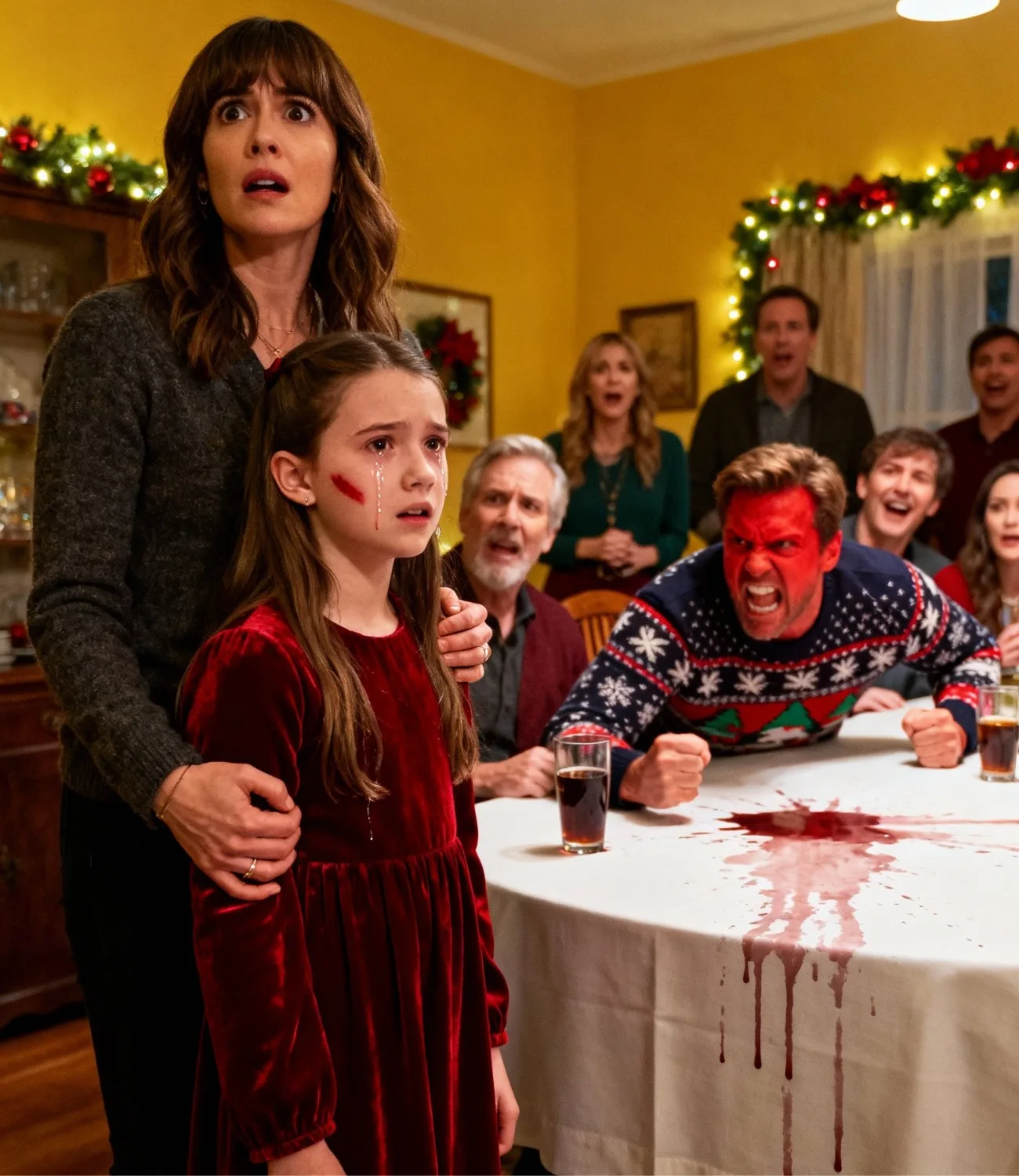
Not the amber liquid spreading across the perfect white tablecloth at my brother’s table like a living stain.
It was the sound.
Sharper than any breaking glass.
The crack of an adult man’s hand striking the cheek of my five-year-old daughter.
That sound split Christmas dinner in half, as if someone had dragged a sharp knife straight through the room. For half a second, no one moved. No one breathed. Even the Christmas lights above the fireplace seemed to freeze, as if they were waiting to see what kind of family we truly were.
My daughter, Lily, stood frozen at the edge of the table, her hand still outstretched. She had only been reaching for a napkin—polite, careful, just as I had taught her to be in other people’s homes. Her curls were tied into two small buns with red ribbons. She wore a velvet dress that scratched her collarbone, because my mother insisted that Christmas meant being “proper.”
The bottle—a vintage-looking whiskey my brother Ethan had been bragging about all evening—fell in slow motion.
As always, he had been monopolizing the attention, talking nonstop about auctions, “investment bottles,” and how most people didn’t understand quality. He had already told the story twice about how he got it for “a bargain,” then corrected himself.
“Not a bargain,” he said, lifting his glass like a priest blessing a congregation. “Six hundred dollars. But it’s worth triple. Easy.”
I remember thinking: imagine being proud of paying six hundred dollars to drink sadness.
Lily leaned forward to grab a napkin for her little cousin, who had spilled cranberry sauce. Her sleeve brushed the edge of the bottle.
Just a brush.
The bottle fell.
The whiskey poured out thick and golden.
The tablecloth drank it in as if it were thirsty.
And Ethan’s face turned purple.
Not red. Purple.
Bulging veins. A clenched jaw, as if he were chewing on his own rage.
Then he hit her.
Not a tap.
Not a reflex.
A slap.
Lily’s head snapped violently to the side. Her eyes went wide, unable to process what had just happened. Her mouth opened, but no sound came out—as if the shock hadn’t yet reached her lungs.
A red handprint bloomed almost instantly on her cheek: five fingers, unmistakable. A signature.
And then… laughter.
It started with my sister-in-law, Marla.
A sharp, nervous laugh—the kind people use to keep the mood going when something horrible has just happened.
“Oh my God… Ethan!” she said, still laughing.
My mother laughed next. That uncomfortable laugh she uses when something is wrong but she refuses to name it. As if laughing first might absolve her of responsibility.
My father joined in, pushing mashed potatoes around his plate.
“Kids are clumsy,” he said, as if Lily had bumped into a chair instead of being slapped across the face.
Someone else muttered:
“That’ll teach her not to touch expensive things.”
As if this were a sitcom and Ethan had just delivered a punchline.
I looked at my daughter and felt my entire body go cold.
Lily’s eyes filled with tears she was still too stunned to let fall. She looked at me—not to accuse me.
But to ask.
To wait.
To wait for the moment her mother would do something.
My hands didn’t shake.
Not yet.
I didn’t scream.
I didn’t throw a plate.
I didn’t leap across the table to hit my brother, even though a wild part of me wanted to.
Instead, something inside me went quiet.
Not a weak silence.
The kind of silence that comes just before a life-altering decision.
I stood up.
The chair legs scraped against the wooden floor like a warning. I took Lily’s small hand. It was warm and sticky—she had been eating bread dough and butter, like any child on Christmas.
“Coat,” I said softly.
She blinked and followed me.
The dining room fell silent behind us, as if the laughter had been a mask someone had just torn away.
We walked toward the coat closet by the front door, passing the family photos lining the hallway: Ethan in his graduation cap. Ethan at his wedding. Ethan holding a ribbon at some charity gala. Ethan always at the center. Ethan always celebrated. Ethan always… forgiven.
I pulled Lily’s pink padded coat from the hook. My fingers moved with a calm I didn’t recognize as my own.
Then I heard Ethan’s footsteps behind us.
“Seriously?” he snapped. “You’re leaving? Over this?”
I turned slowly.
Ethan filled the doorway as if he owned the air in the house. He was wearing a Christmas sweater with a smiling reindeer on it. It might have been funny, if he hadn’t just slapped a kindergarten-aged child.
“I barely touched her,” he said. “Kids need consequences.”
I looked at Lily. Her cheek was already swelling. The tears were finally streaming down her face, silent and burning.
“No,” I said.
He scoffed.
“No what?”
“Don’t pretend you didn’t do what you did.”
My mother appeared behind him.
“Sweetheart,” she said in that pleading tone she uses when she wants peace more than truth, “it’s Christmas.”
My father stepped closer.
“Come on,” he said. “Don’t make a scene.”
Those words hit harder than the slap.
My daughter had been struck in the face, and their biggest concern was the atmosphere.
I looked at all of them—my mother with her forced smile, my father with his avoidance, my brother with his arrogance—and I understood something with terrifying clarity:
They weren’t really surprised.
This wasn’t new.
It was just the first time it had been loud enough that I could no longer pretend it didn’t exist.
I zipped Lily’s coat and knelt to put on her boots.
“You’re overreacting,” Ethan said. “It was a reflex.”
Lily flinched at his tone. Her small body stiffened like a rabbit sensing a hawk.
I stood up and squeezed her hand tighter.
“I’m not overreacting,” I said. “I’m protecting my daughter.”
My mother stepped forward.
“You’re going to ruin Christmas.”
Ethan threw his hands up.
“You’re ruining it. Over a bottle.”
I looked at him for a long moment.
“No. Over my daughter.”
Then I opened the front door.
The cold December air hit my face—sharp, clean, real.
I walked out with Lily without looking back.
That night, Christmas ended for them.
But for my daughter, it became the day she learned something she will carry for the rest of her life:
That her mother will always choose to stand by her side.
Even if that means walking away and never coming back.