A Widow Bought an Old Plot No One Wanted… But When She Dug to Plant Corn, She Found a Secret
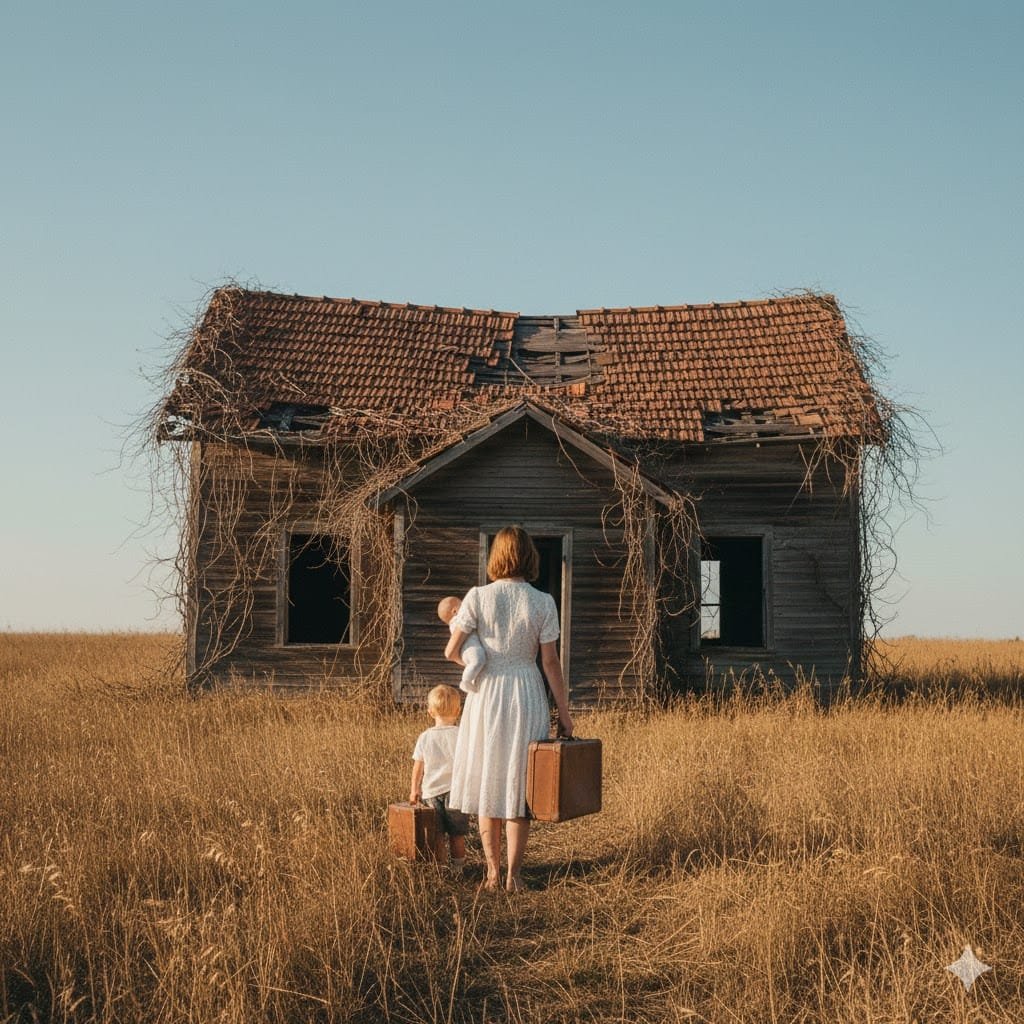
When Teresa stepped down from the cart and felt the dry earth crack beneath her sandals, she knew there was no going back. The sertão sun forgave no one: it came down like judgment on broken clay-tile roofs, on twisted trunks of dried-out trees, on streams turned into scars of mud. It was the early twentieth century, when Brazil’s backlands seemed to groan with thirst, and water was worth more than a coin. Anyone with a deep well or a natural spring was seen as blessed; anyone without learned to live counting drops, carrying tins from far away, praying for rain that took so long hope itself turned to dust.
Teresa was thirty-two, but grief had added years to her eyes. Just months earlier, a fever had taken her husband in three days—without warning, without permission, without goodbye. In an instant she became a widow, with two little daughters and a handful of savings guarded like a candle flame in the wind.
Going back to her parents’ home would mean accepting the same fate as always: people’s pity, a cramped life, the feeling of being in the way. Staying alone meant betting her entire life on an idea many called madness:
“I will manage.”
That was why she bought the plot nobody wanted.
It was land abandoned for years, far from any river, with a house half in ruins and soil so hard not even grass dared to grow. “It’s cheap,” the notary warned, in that voice that sounds like both advice and threat. “But there’s no future here.” Teresa listened in silence. She didn’t buy a future—she bought a chance.
The house she found looked more like a memory than a home: floorboards that creaked, a door hanging from a single hinge, holes in the roof where the wind whistled as if it, too, were hungry. Ana, four years old, squeezed her mother’s hand and stared with wide eyes.
“Here, Mom?”
Teresa swallowed hard and put into her voice a confidence she didn’t yet feel.
“Here, sweetheart. We’ll fix it. You’ll see.”
That first night they slept on old blankets on the floor, listening to the countryside breathe and the roof complain. Rosa, the youngest, stirred in her sleep, as if her body already knew what her mind could not yet understand. Teresa stayed awake, watching her daughters and feeling the weight of her decision. She wondered in silence whether a woman’s strength could hold up an entire life.
At dawn, light slipped through the cracks like a promise. Teresa tied the baby to her back with a cloth the way her mother had taught her, grabbed the humblest and most faithful tool there is—a hoe—and stepped outside.
She worked as if work were prayer. She patched holes, nailed boards, scraped away years of filth, rebuilt what she could with her hands. Within days the neighbors began to appear—but not to help. To judge. They stood at the fence, arms crossed, watching the way people watch someone else’s mistake.
The first was Dona Sebastiana, a sturdy woman, sun-weathered, the kind who survives by learning to harden her voice.
“Are you the new owner?” Teresa nodded without stopping her hammering.
“Alone, with two children… on this land.” Sebastiana clicked her tongue. “Nothing grows here. The previous owner was a man, strong, and even he left. You won’t last two months.”
Those words weren’t just words—they were stones. Teresa felt the provocation but didn’t answer with anger.
“I don’t give up easily,” she said.
Sebastiana let out a dry laugh and walked away, leaving behind that bitter taste humiliation has when you swallow it just to keep going.
And Teresa kept going.
For weeks she carried water from the community well, nearly half an hour on foot. Ana came with her in short steps, holding a small tin proudly, happy to feel useful. Rosa slept in the shade when the heat became too much. Teresa planted beans, corn, squash; she spent her last savings on seeds the way one buys hope. She watered with heavy buckets. And still—nothing. The sprouts came up weak, trembled for two days, and died as if the earth itself rejected them.
In the village, whispers followed her.
“Poor girls, suffering because of their mother’s stubbornness.”
“She’ll come back with her tail between her legs.”
Teresa heard it all, every sentence tightening her chest. But when she returned to the plot and saw Ana humming under a dry tree and Rosa’s little face calm, she remembered why she was there: because those girls would not grow up learning that the world decides a woman’s fate.
That night, hands aching and back knotted, Teresa knelt beside their makeshift bed and prayed softly:
“Lord, I don’t know if I did right, but now I’m here. My daughters need me. Give me strength… and if there’s a blessing buried in this land, show me where.”
The next morning she made a decision that looked like desperation—but was really faith with grit.
If the surface wouldn’t give, she would dig deeper.
She chose a corner of the land and began opening a large hole—not a seed hole, but nearly two meters deep. Every swing of the hoe was a fight with the ground; every strike felt like it demanded years of her life in return.
The neighbors mocked:
“She’s digging her own grave!”
Teresa didn’t answer. She just dug.
Day after day the work grew harder and the exhaustion more cruel. One night Ana asked, lying on the thin mattress:
“Mom… are we going to leave?”
Teresa felt something tear inside her, but she didn’t show it.
“No, sweetheart. Sometimes people say we can’t because they never dared to truly try. But we’re not giving up.”
Ana curled close and whispered:
“I believe you.”
Teresa lied to protect her daughter, because inside, fear was speaking too.
Then came the morning when the earth changed its sound.
Teresa was already so deep she almost disappeared inside the hole. Ana played at the edge, kicking loose dirt and making up songs. Teresa drove the hoe into the ground and felt a different resistance—like the soil had finally loosened its jaw.
She froze, heart pounding against her ribs.
She dug again.
The earth was damp.
“Ana, step back a little,” she said, in a voice that didn’t come from her throat but from her soul.
She dug faster, hands shaking. And then she heard a whisper that wasn’t wind or insect.
It was something alive beneath the earth.
Water.
At first it seeped slowly, like a shy tear. Then, as if the ground cracked in relief, the water surged up, filling the bottom of the hole, soaking Teresa’s legs, pouring out clear, cool—impossible.
Teresa dropped the tool and fell to her knees in the mud that was turning into a river. She laughed and cried at the same time, plunging her hands into it like someone who needs to touch a miracle to believe.
“Ana! Water! We have water!”
Ana came closer, eyes huge.
“Where did it come from, Mom?”
Teresa looked at her, face drenched, and could only say the truth she felt:
“From God, sweetheart… from God.”
That night Teresa didn’t sleep. She sat on the porch watching the spring run without stopping. She thought about a garden, animals, green corn growing where there had only been cracks. But she also thought of something else: women walking far with tins on their heads, thirsty children, starving animals.
And she asked herself a question heavier than gold:
Is a blessing meant to be kept… or shared?
At first she worked quietly. She dug little channels, guided the water, watered generously. In a week, green shoots appeared. In two, the garden was alive. In a month, Teresa’s plot was the only stain of hope in the middle of the desert.
The neighbors began to look differently. No more mockery—now it was disbelief.
Dona Sebastiana was the first to cross her own pride. She stopped at the fence, face hard like someone who didn’t know how to apologize.
“Dona Teresa… where do you get water?”
Teresa stopped watering. She could lie. She could charge. She could repay the contempt with interest. But she looked at Ana playing near the water and remembered the nights of fear. And she decided not to repeat the same coldness.
“I found a spring,” she said simply. “I dug deep, and it came up.”
Sebastiana swallowed.
“Would you sell water? I… I can pay.”
Teresa took a breath and shook her head.
Sebastiana lowered her eyes, humiliated, as if the world were handing back what she had once given. Then Teresa called her before she left:
“I’m not selling. I’m giving. Whoever needs it can come with buckets, barrels—whatever they have. No one will die of thirst while this water runs.”
The news spread like fire over dry grass.
The next day one came, then two, then five… soon whole families. Some came quietly. Some with tears. Some still suspicious, as if kindness hid a trap. Teresa welcomed them all the same:
“There’s enough for everyone.”
With water, the community came back to life. And with that new life came something even harder: respect.
One day Sebastiana cried in front of Teresa, the truth bare:
“I was cruel to you. I talked, I doubted… and now you’re saving my crops.”
Teresa touched her shoulder.
“I don’t hold a grudge. We were all desperate.”
From then on, the woman who had judged her first became her fiercest ally: defending her name, helping with the girls, showing up with eggs and flour and willing hands.
That was when Antônio appeared.
He arrived in a cart with supplies, face marked by sun, hands worn by labor.
“Dona Teresa,” he said, taking off his hat. “I’m Antônio. I heard about your water… and your generosity. My crop was dying. You let me take what I needed. I came to thank you.”
He unloaded flour, beans, brown sugar blocks, dried meat, and stronger corn seeds. Teresa was speechless.
“You didn’t have to…”
“Yes, I did,” he interrupted gently. “When you receive life, you learn to give it back.”
Antônio returned the next day… and the next. Sometimes he brought tools, sometimes he fixed the roof, sometimes he taught planting methods. Ana adored him quickly, the way children adore someone who truly sees them. Rosa smiled when she saw him, even before she could say his name.
Teresa tried to protect herself. Parts of her heart were still in mourning, like a house locked for fear of being robbed again. But slowly, something inside her—something she believed had died with the fever—began to breathe.
Months passed and the plot transformed: a small reservoir, a drinking trough for animals, firm rows of corn, pumpkins round as promises. The community that once laughed now called her “Dona Teresa” with respect. And Antônio became a constant presence: helping without asking, staying for meals, repairing fences, lifting what she couldn’t lift alone.
One afternoon Sebastiana said, with the wisdom of someone who had lived many lives:
“That man doesn’t come only out of gratitude.”
Teresa wanted to deny it, but couldn’t find the strength to lie to herself.
It was Antônio who one day, while opening new furrows, asked her with truth in his eyes:
“Why didn’t you marry again?”
Teresa felt the question strike.
“Because I’m afraid. Afraid to trust and lose… afraid to bring someone into my daughters’ lives and one day watch him leave.”
Antônio nodded slowly.
“I was afraid too. That’s why I never built a family. But now… now I’ve met you. And for the first time I want a future that isn’t only work. I want a home with laughter. I want to belong.”
Teresa didn’t answer with words. That night, looking at the starry sky, she prayed again:
“Lord, show me the way.”
And she felt something soft—not an exact answer, but a peace that said: “It’s okay to go on.”
But happiness, in the real world, rarely comes without being tested.
At the village fair, Teresa heard a name that made her skin crawl: Colonel Barreto. People said he was buying lands with water. That he paid well… and whoever refused, suffered consequences.
Two weeks later, a well-dressed man arrived in a carriage and spoke like the “yes” was already decided.
“I represent the Colonel. He wants to make an offer for your property. Twice what you paid.”
Teresa looked at her furrows, her garden, her daughters playing near the spring.
“It’s not for sale.”
The envoy smiled—knife-sharp.
“The Colonel doesn’t usually accept a no. I hope you don’t regret it.”
The threat became real on a Monday, when an officer arrived with a sealed document: a supposed old debt from the previous owner to the Colonel, a legal claim, thirty days to vacate. Teresa felt the world shatter again.
Antônio read it and his jaw tightened in rage.
“This is a hit. The dates don’t match. They forged it.”
And yet the fear was real. How do you fight a man with money, lawyers, influence?
The answer came from where Teresa least expected: the same community that once despised her.
Father Miguel wrote letters. The notary confirmed Teresa’s deeds were legitimate and that those “debts” had been registered only recently—suspiciously. Sebastiana proposed a petition: everyone would declare Teresa bought legally and worked honestly. Within two days, over fifty families signed.
Because the water Teresa had given freely did something deeper than save crops: it created unity.
Antônio paid to hire a young lawyer, Dr. Paulo, who was outraged by the forgery.
“If we prove this, the Colonel will be in trouble,” he said.
Teresa clung to that sentence like someone clings to a plank in floodwaters.
On the day of the hearing, Teresa dressed her daughters in the nicest clothes they had. Not to soften the judge, but to remind herself who she was fighting for.
The courtroom was a small hall in the town hall. Across the room sat Colonel Barreto, large, elegant, cold, with two lawyers who seemed to speak the language of power. Teresa felt like David facing Goliath.
The Colonel’s lawyer spoke of laws and rights as if justice were only paper. Then Dr. Paulo spoke with a firmness money couldn’t buy:
“These documents are forged. They were registered last week, right after Teresa refused to sell. We have witnesses, the notary, and fifty families signing.”
The judge read the community statement, and the silence grew heavy.
When Teresa testified, her voice trembled, but it didn’t break. She spoke of widowhood, ruin, working until she bled, of the spring and her decision to share.
“I did nothing wrong, Your Honor. I only wanted to raise my daughters with dignity. No one wanted this land. I transformed it. And now they want to take it because they discovered it’s worth something.”
Father Miguel spoke with the truth of one who has seen suffering:
“I saw her arrive alone, despised. And when God blessed her, she shared. This is not justice—it is theft.”
Antônio spoke not as a hero, but as a man of the community:
“If we allow this, we’re saying the law means nothing when there is money.”
The judge asked for a week to decide. It was the longest week of Teresa’s life. She barely slept. But she wasn’t alone: Sebastiana came with coffee, neighbors with words, Antônio with steady presence.
When the decision came, the courtroom was full.
The judge read: the debts had been forged to defraud a legitimate purchase; the property belonged to Teresa. Case closed.
Teresa cried like someone dropping a stone carried for years. Antônio held her tight. The community applauded as if applause could repair what they once failed to do. The Colonel left furious, defeated by something his power could not understand: a people united around a woman who, instead of returning contempt, returned water.
After that, life continued—and that alone was miracle enough.
Antônio kept coming to the plot, but now with a different light in his eyes. Ana began calling him “Daddy Antônio” without anyone teaching her. Rosa ran toward him shouting “Tonho” in her little voice.
Teresa watched it all with joy and fear mixed together… until the day Antônio, in the garden, knelt with a simple silver ring.
“I know you’re afraid,” he said. “So am I. But I promise you: as long as I live, I’ll care for you and your daughters as my greatest treasure. Marry me. Let me be a real father. Not because you need me… but because I need you.”
Teresa looked at her girls, looked at the man who stayed when the storm came, and understood that loving again wasn’t betraying the past—it was honoring the life still left.
“Yes,” she whispered.
They married in the small village church. A simple wedding, with wildflowers, Sebastiana’s tears, Father Miguel’s smile, children running and laughing. It wasn’t only a marriage—it was proof that hope can defeat loss.
Over the years, the plot prospered. They had a son, Miguel, named after the priest who helped them, and the spring kept running as if the sky had connected it directly to Teresa’s land. The reservoir grew, supplied more families, and the desert slowly became garden.
Ana grew strong. Rosa grew mischievous. Miguel followed his father like a shadow. And when Teresa, now with gray hair, sat at sunset on the same porch where she once cried in fear, she watched her grandchildren play near the water and finally understood the true secret of that land:
it wasn’t only a spring hidden under the soil.
It was a lesson buried for anyone brave enough to dig.
Because sometimes the greatest treasure isn’t on the surface—where everyone looks and judges.
Sometimes it’s below, waiting for someone with faith, honest work, and the courage to keep striking the earth…
even when the whole world laughs.