Goliath, the Healing Horse
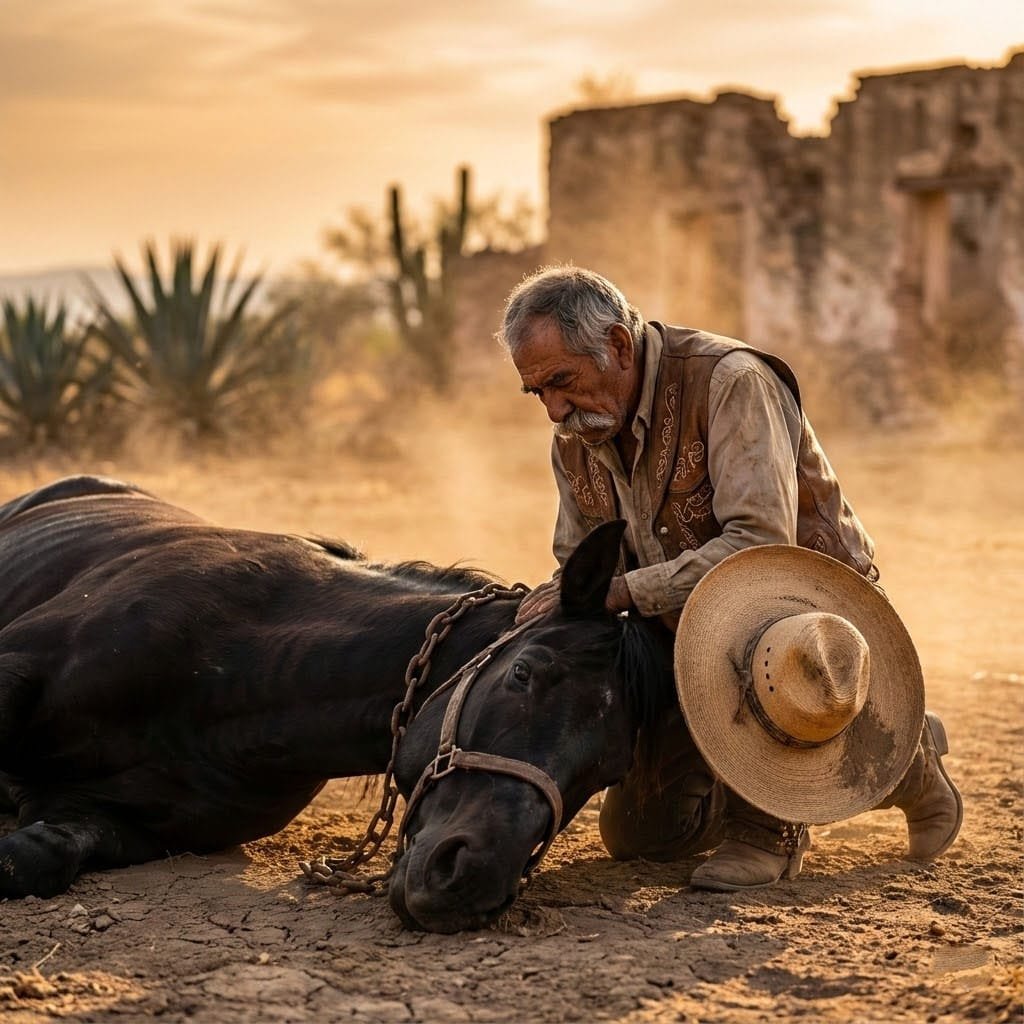
Dylan Cross was a man with a past marked by mistakes and pockets empty of hope. He worked as a ranch hand on the slopes of the Sierra Madre, trying to bury his own failures under the weight of hard labor.
One cold October morning, while carrying hay, he heard a sound that made him freeze: it wasn’t the wind whistling through the pines, but a labored, heavy, wet breathing coming from the dense forest, where the trails disappeared among ancient trees.
Following the sound, Dylan arrived at a shadowy clearing and was faced with a frightening scene: at the base of a massive oak stood a colossal black horse, nearly two meters tall, looking like a shadow pulled from a legend.
But what made Dylan’s stomach churn wasn’t the size of the animal—it was the thick industrial chains wrapped around its neck and chest, digging into its skin and holding it captive like a condemned prisoner.
The horse was starving, dehydrated, and on the brink of collapse. Attached to one of the chains was a note, written in shaky handwriting:
“His name is Goliath. I can’t feed him anymore. He’s too big, too wild, too dangerous. I’m sorry. Maybe someone else can save him.”
Dylan’s instincts told him to leave and call the authorities. An animal of that size, described as “wild,” could crush his skull with a single kick. Besides, he barely had money for his own food—how could he care for a titan that ate as much as three ordinary horses?
Yet Dylan knelt and looked into Goliath’s amber eyes. He saw no anger, no malice. He saw a deep intelligence, endless sadness, and a silent question that pierced his soul:
“Will you help me, or will you just watch me die?”
Against all common sense, Dylan ran for his tools. He spent hours in the rain, cutting the chains link by link, speaking to Goliath in the gentle voice of someone who understands the pain of being trapped.
He was terrified, thinking that when the last chain fell, the “monster” would take revenge on the first human he saw.
But when the final link hit the ground with a thud, something incredible happened. Goliath didn’t run. He didn’t attack. He exhaled a long sigh and rested his enormous head on Dylan’s shoulder, closing his eyes. Dylan felt an electric current run through his body, a peace he hadn’t felt in years. His hands, which always trembled with anxiety, stayed still.
What Dylan didn’t know was that the note lied out of fear. Goliath wasn’t dangerous because of his temperament, but because of the gift he possessed: a supernatural power of empathic healing.
A few days later, Dylan brought Goliath to the ranch. A local boy, who hadn’t spoken since a family trauma, approached the horse, touched him, and for the first time in three years, spoke a word.
The news spread like wildfire through the nearby villages. War veterans with broken souls, people with terminal illnesses, and broken families began arriving at Dylan’s humble corral. Goliath didn’t need to be tamed; he tamed the inner demons of those around him.
The note said he was “too wild,” but the truth was that Goliath was too pure for a world full of fear. Dylan didn’t just save a horse; he saved a being who would end up saving an entire community.
And so, amid broken chains and hopeful gazes, Dylan discovered that some extraordinary creatures exist to heal invisible wounds—and that courage and compassion can change entire destinies.