He Left Her Only With Dry Trees…
Years Later, Her Brothers Begged Her to Teach Them
Elena Mendoza grew up learning how to disappear inside her own home.
While her brothers, Raúl and Javier, went off to the city to study and returned only for holidays and celebrations, she stayed in the countryside, a silent presence. She cooked, cleaned, kept the household running—and when illness came, she cared for her father, Don Ignacio, a man hardened by life and too proud to recognize love when it arrived in the form of service.
For years, Elena heard the same message in different words: that she “did nothing,” that she “only stayed at home,” that she “didn’t know what real work was.” And still, she stayed. Because someone had to.
On an April morning, three weeks after Don Ignacio’s death, Elena sat in the office of Notary García, her hands clasped over her simple skirt. The room smelled of old paper and polished wood. Her brothers took the main seats, confident, as if they already knew what was coming.
“I will now read the final wishes of Don Ignacio Mendoza Vázquez,” the notary announced, adjusting his glasses.
Elena held her breath. She didn’t expect a fortune. But deep down, she believed she would receive at least something that would allow her to start over after so many years devoted to that house.
“To my firstborn son, Raúl Mendoza Ordóñez, I leave the family home and the irrigated lands by the river, totaling twenty hectares.”
Raúl smiled, satisfied. They were the best lands in the region.
“To my second son, Javier Mendoza Ordóñez, I leave ten hectares of olive grove, Grandmother’s house in town, along with the tractor and farming equipment.”
Javier nodded proudly. The olive grove produced high-quality oil that sold well.
Elena swallowed hard. Now it would be her turn.
“And to my daughter, Elena Mendoza Ordóñez, I bequeath the upper plot, with its fruit orchard.”
Silence fell heavy.
Elena blinked, confused. The “upper plot” was rocky land far from the river, where her father had once tried to plant fruit trees years earlier. The project had been abandoned. Almost no one went there. In practice, it was “bad land.”
Raúl let out a restrained chuckle.
“Only that?” Elena asked in a thin voice.
The notary looked at her over his glasses.
“There is a personal note your father left for you.”
He handed her a sealed envelope. Elena opened it with trembling fingers and read her father’s uneven handwriting, as if each word were another humiliation:
“Elena, I leave you the dry trees up on the hill.
With these dead sticks you will learn the value of effort—something you never understood by staying at home like a coward.
Maybe now you’ll learn what it is to truly work.”
Tears burned her eyes, but she refused to let them fall. She folded the note, slipped it into her pocket, and walked out.
Outside, under the sun, her brothers didn’t miss the chance.
“Nice gift the old man left you,” Javier mocked. “But honestly, it’s fair. We inherited what we helped build.”
“As if cooking, cleaning, and caring for him while he was sick wasn’t work…” Elena replied bitterly.
“Any maid could’ve done that,” Raúl cut in with contempt. “We sweat in the fields and in business.”
Elena pressed her lips together and walked away. The cobblestone street watched her pass with a straight back and empty eyes. She would not cry there. She would not give them that satisfaction.
At home, she packed a small backpack with water and food. She needed to see her inheritance. With her own eyes, she needed to understand the size of her father’s final cruelty.
The next morning, she climbed the dirt road to the upper plot.
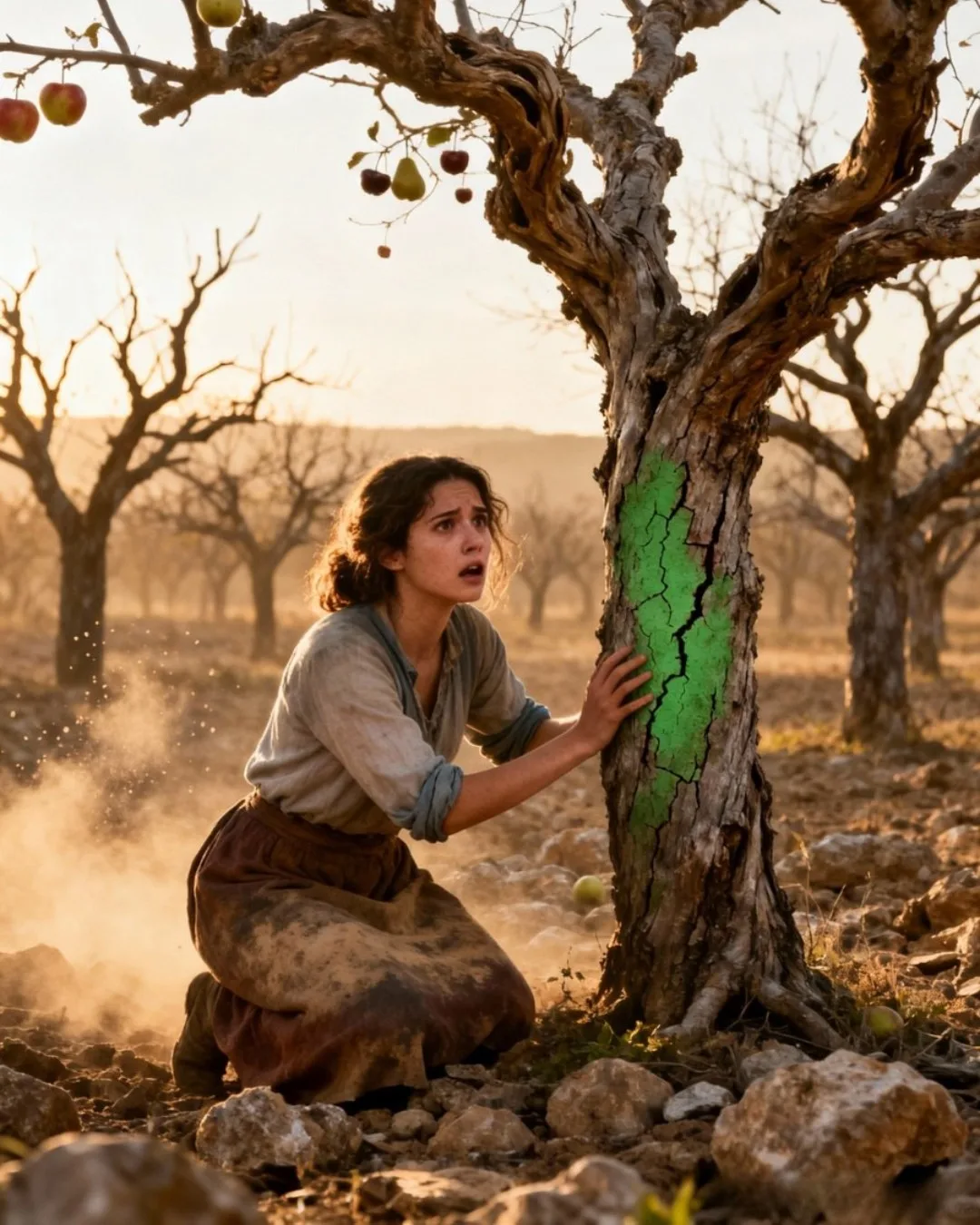
The wind was dry. The ground was hard and full of stones. And there the trees stood: twisted trunks, brittle branches, barely any leaves. It was sad. It was ugly. It was… the perfect inheritance for someone her father considered “useless.”
Elena walked among them, gently touching the cracked bark. That was when she noticed something strange: some trees had old marks, like scars. And on one of them, near the roots, there was a rusted strip, as if something had been tied there long ago.
She knelt and began to dig with her hands.
Her fingers found metal.
Then more.
And more.
Elena brushed away the dirt and slowly pulled out something that made no sense there: a heavy iron box, caked in dried mud, hidden beneath the roots of a “dead” tree.
Her heart pounded.
She carried the box to a rock, wiped it with her sleeve, and forced the lid open with a stone. The metal groaned… and opened.
Inside was a bundle wrapped in waxed cloth. And inside that bundle: old documents, maps of the region, a deed, and a folder of notes.
Elena read, stunned.
The upper plot wasn’t “bad.” It sat above an aquifer, a rare source of underground water in the area—and her father had known. Years earlier, a technician had taken measurements and indicated there could be enough water there to irrigate major crops. But for some reason, Don Ignacio never spoke of it.
Among the papers was an old report and a note written in dark ink:
“Water where no one looks.
Whoever understands the soil will win.”
Elena sat there, breathless.
For days, she returned to the land, studied the maps, read and reread the notes. And she decided to do what she had always done: work—truly work—only now, for herself.
With the little money she had saved and the help of a small rural loan, Elena hired a geologist. The tests confirmed it: there was water. Plenty. The depth made it challenging, but it was possible.
She installed an artesian well.
When the water finally burst forth—clear and strong—Elena cried for the first time. But not from humiliation. From relief. From justice. As if, at last, she truly existed.
From that point on, she transformed the upper plot.
She planted a new orchard, now irrigated. She built a simple, efficient drip system. She studied precision farming, sought guidance from cooperatives, learned to sell directly to markets and small chains.
Within months, the land that had been “rocky” was green.
Within two years, her production surpassed her brothers’.
And it didn’t take long for Raúl and Javier to feel the hit.
The river that irrigated their land began to fail during dry periods. Costs rose, yields fell, and debts appeared. Meanwhile, the upper plot—the “useless inheritance”—thrived with its own water and Elena’s organization.
One hot afternoon, when word spread across the region about Elena’s latest major sale, her brothers showed up.
They arrived by car, dressed well, carrying the same pride as always—only now their eyes held urgency.
“Elena…” Raúl began, forcing a smile. “We heard about the well. The system. The production…”
She looked at them in silence.
Javier cleared his throat, uneasy.
“The truth is… we’re going through a rough time. The river water isn’t enough. And…” He swallowed. “We want you to teach us. How you did it. How you managed.”
Elena took a slow breath. The notary’s office returned to her like an old cut: the laughter, the words, the contempt.
She could humiliate them. She could throw every phrase back like a stone.
But she looked at her callused hands, at the rows of plants, at the water running through the irrigation lines—and she understood something her father never did: real work isn’t what shouts. It’s what sustains.
“I’ll teach you,” she said calmly. “But on one condition.”
They exchanged glances.
“You will admit, in front of everyone, that I worked my whole life. That caring for a home and for a sick man is work. That you called me a coward without knowing what I carried. And you will stop using our father’s name as an excuse to disrespect the one who stayed.”
Raúl tried to argue, but his throat closed. Because for the first time, he wasn’t facing the sister who stayed quiet. He was facing a woman who had built something he didn’t know how to build.
“Alright,” he said finally, softly. “We admit it.”
Elena nodded.
The following week, they returned—and in front of workers, neighbors, and buyers, they said what they had never said:
“Elena was the one who held everything together. She worked. She cared for our father. We were wrong.”
Only after that did she teach them—not just irrigation, not just planting and management… but something far harder.
She taught them respect.
Over time, the relationship didn’t turn into a fairy tale. Wounds don’t vanish overnight. But for the first time, Elena stopped being the “faithful shadow” of a house and became the owner of her name, her destiny, and her voice.
And the “dry trees” that had been left as punishment…
became the place where life began again.
Because no one imagined that beneath dead branches
there was hidden water—and strength enough to change everything.