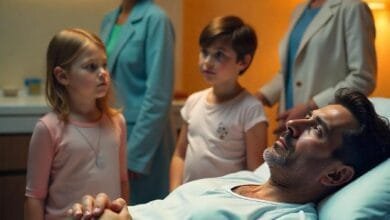
When the doctor repeated my son’s exact words

—said over the phone—that he was at his mother-in-law’s birthday party and that if I died, they should let him know later, I felt like the hospital ceiling collapsed on top of me.
My blood turned to ice.
And strangely… my hands stopped shaking.
My fear of death vanished in an instant, replaced by a cold, brutal clarity.
My son thought I was just a helpless old woman, about to fade away—good for nothing but becoming “a burden.”
But he forgot one small detail.
A legal detail.
And that detail would cost him far more than an apology.
My name is Carmen.
I’m 72 years old, and I’ve spent my entire life working in my birriería in the Santa Tere neighborhood of Guadalajara. It was over that stove, inside that heat, with that smell of spices and roasted meat, that I built everything.
Everything.
Including my son’s “success.”
The Beginning: A Woman Who Sacrificed Everything for Love
That day, I pulled down the metal shutter of my shop and listened to the familiar screech that marked the end of yet another battle. My bones cracked louder than the rusty hinges.
But I didn’t complain.
I adjusted my blue rebozo over my shoulders—the same one that smells like dried chiles, cloves, cinnamon, and charred meat. A scent that sinks into your skin as if work becomes part of your body.
And I was proud of it.
That smell paid for my son’s degree.
That smell built the walls of my home.
That smell kept me standing after I became a widow.
I walked slowly along the sidewalk, thinking about weekend orders, calculating how many kilos of meat I’d need… when the buzzing in my ears returned.
Like a furious swarm trapped inside my head.
The doctor had warned me my blood pressure was high—dangerous, a ticking bomb. She told me to rest, to leave the business.
But I’m stubborn.
And in Jalisco, we don’t back down because of a “little dizziness.”
“It’s just exhaustion,” I told myself.
“I’ll get home, drink some tea, and I’ll be fine.”
But when I tried to cross the street, the asphalt turned to water beneath my feet.
Car lights stretched like neon ribbons. The traffic noise faded, as if someone turned the volume down on the world.
I reached out for a pole, a wall, anything.
I grabbed only air.
The last thing I thought before everything went black was the pressure cooker at home:
“Did I close it properly?”
The Middle: The Hospital and the Loneliness That Hurts More Than Surgery
When I woke up, I felt cold—but not the night air of Guadalajara.
This was clinical cold.
Metallic cold.
Hospital cold.
The white light above me stabbed deep into my skull.
I was on a gurney with an IV in my arm—the same arm that once carried sacks of corn and boiling pots, now looking fragile under fluorescent lights, marked with age spots and raised veins.
My hip burned with sharp pain that stole my breath.
A young nurse approached. She looked like a girl and gave me that rushed pity people often reserve for elders who arrive alone.
She told me I’d collapsed on the street, that strangers called an ambulance, and my blood pressure was dangerously high.
Then she said the word I feared most:
surgery.
And after that came the question that hurt more than any broken bone:
—Do you have family? Someone we can call?
They searched my bag, found my ID, but my phone was locked.
I swallowed hard.
Asked for the phone.
My hands trembled so badly I could barely type the passcode.
And the passcode was my son’s birth date.
Not mine.
I looked up Roberto.
My only child.
My pride.
The “successful lawyer” who barely comes to the neighborhood anymore because he says it “ruins his shoes.”
I called.
It rang once… twice… three times…
Each ring hit my chest like a hammer.
In my mind, I still tried to defend him:
“He must be busy…”
“He must be in a meeting…”
“He must be driving…”
I closed my eyes and prayed to Our Lady of Zapopan—not to save my hip, but to make my son answer the phone.
He didn’t.
The call went to voicemail.
And lying there alone, I drifted back in time, as if the hospital smell turned into wood smoke and raw masa.
I saw myself waking at four in the morning for decades, stirring giant pots, chopping onions until tears became routine, burning my hands on the griddle.
I looked at my hands on the hospital sheet—crooked, spotted, swollen with arthritis.
Hands that burned so his could stay soft.
I remembered the day he came home with an acceptance letter to the most expensive private university in the city. He was thrilled. I felt the ground open beneath me, because I didn’t even have money for the enrollment fee.
I didn’t tell him.
I sold my wedding rings.
Heavy gold.
A piece of my history disappearing.
When I gave him the money, I said it was “business savings.”
He never knew I sold my past to buy his future.
And it worked.
He grew up. He became “someone.”
But the success I paid for with my body was the same success that took my son away from me.
Then he met Patricia.
I’ll never forget the first time she stepped into my home. She wrinkled her nose. Wiped the chair with a tissue before sitting down. She said my house smelled like grease, and that birria clung to her “designer clothes.”
Slowly, Sundays disappeared.
Visits became rare.
And calls only happened when he needed money.
For a new car.
A vacation.
A mortgage payment.
And I—foolish mother—always said yes.
I thought giving money bought me a sliver of affection.
But on that gurney, I understood the truth:
I wasn’t “mom” in his life.
I was the bank.
The Turning Point: The Sentence That Kills Love
Then Dr. Salas walked in.
I recognized him immediately—he’d been a customer at my shop for over fifteen years. The kind who always orders extra meat and leaves a good tip.
But this time he wasn’t smiling.
He looked ashamed.
He came closer, placed his hand over mine, and said he had to be honest before surgery.
Then he said:
—Carmen… your son answered the phone.
My heart jumped.
I imagined he was coming.
Or stuck in traffic.
Or at least trying.
But the doctor took a breath and repeated his exact words:
—He said he’s in Valle de Bravo celebrating his mother-in-law’s birthday… and that if you die, we should tell him later. Because he couldn’t ruin the party.
I didn’t cry.
I didn’t scream.
I didn’t panic.
Everything went silent inside me.
And something died right there.
Not my body.
My attachment.
The doctor watched me closely, as if he sensed something dangerous had shifted. Then he lowered his voice and gave me a key I didn’t know I needed:
—Does your son really know whose name is on the property papers? Who the real owner is?
That’s when I woke up.
Roberto walked around his luxury office in Guadalajara’s financial district, showing off his success.
But he forgot the main thing:
I bought that office. Peso by peso.
With birria.
With dawn.
With burned hands.
The deeds were in my name.
I had only given him the right to use it—for free—so he could shine, so he could “be someone.”
But the owner was always me.
I looked the doctor in the eyes and said:
—I don’t need a priest. I don’t need goodbyes. I need a notary. Now.
Before the anesthesia.
Before sleep.
Before life decided anything for me.
The Confrontation: Cheap Flowers and Real Panic
Three days after surgery, the door opened.
Roberto walked in with a rehearsed smile and a bouquet of carnations bought at a traffic light.
Flowers of guilt.
Flowers of hurry.
Flowers without love.
He opened his arms and said he’d prayed for me, that it was a scare, that the moment he found out he rushed over.
He tried to hug me.
I raised my hand—weak, but firm enough to build a wall.
He froze.
Sat on the edge of the bed and started reciting excuses:
Bad signal on the highway.
Phone malfunction.
A “vital deal for the family.”
He “flew” the moment he heard.
I let him talk.
Like you let a child lie when you already know the truth.
When he paused, I looked him in the eyes and said:
—Save the act. Tell me how the cake was at your mother-in-law’s party.
His face drained of color.
He stammered.
And I continued:
—I truly hope it was worth it… because that weekend cost you more than you realize.
—Mom… you’re delirious…
I pointed my eyes toward the envelope on my bedside table.
—Open it.
He opened it with contempt.
But as he read, his arrogance crumbled.
Notary seal.
Date and time: minutes before my surgery.
Clear clause:
I revoked the free lifetime right to use the building.
I annulled the previous will.
And in case of my death, my assets would go into a charitable trust.
Roberto looked up.
No more mockery.
Only panic.
—That can’t be! That’s my office! My work! My life!
I inhaled, feeling pain in my hip…
But peace in my soul.
—For years I was your mother. But you confused me with your bank.
—When the doctor called you, you decided I was already dead.
—So that day, my money died for you too.
He tried to argue, to shout, to blame.
But I was done being the floor people walk on.
The End: The Peace of Taking Your Life Back
When I was discharged, it wasn’t Roberto who held my walker.
It was my friend Estela.
She helped me into the taxi, carried my bag, adjusted my rebozo.
When I got home, silence greeted me.
That silence used to hurt.
Now it felt like rest.
I sat in the kitchen.
Ate a jericaya with the burnt sugar crust I love.
And Estela told me what happened:
Roberto made a scene when they changed the locks at the office.
He shouted, threatened, claimed they were stealing from him.
But I didn’t steal anything.
I simply recovered what I built with forty years of work.
Months passed.
My hip healed.
I returned to the birriería—now supervising more than lifting.
The building was rented quickly.
The rent pays my nurse.
My medicine.
My small joys.
I haven’t heard from Roberto again.
And sometimes I miss the boy I raised…
But I don’t miss the man who treated me as dead.
In the living room, there was still a photo of him in his graduation gown.
I stared at it.
It hurt.
Because a mother doesn’t stop being a mother.
But I opened the drawer in the sideboard…
And placed the photo face down.
Like closing a book I will never reread.
That night, I lit a candle at my altar.
Our Lady of Zapopan watched with merciful eyes.
I didn’t ask for Roberto to return.
I didn’t ask for repentance.
I asked for me.
Strength.
Peace.
And the courage to live what I have left with my head held high.
My son chose his path.
I chose mine.
And even though it hurts, I sleep спокойно.
Because in my home…
And in my life…
the only owner is still me.
Moral: Dignity is not begged from children. It’s protected—through boundaries, legal papers, and self-respect.