From the Dump to a New Beginning
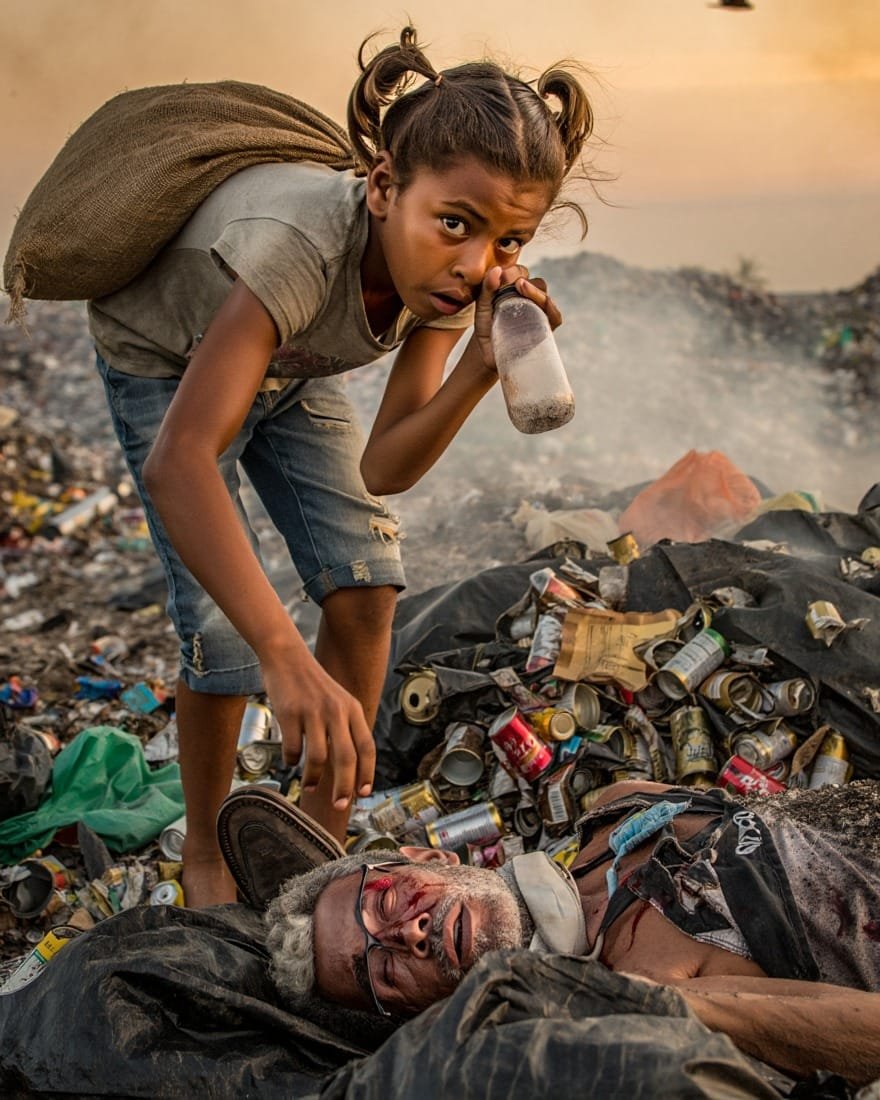
When the garbage truck drove away, leaving behind the heavy smell of the end of the day, Luísa, only 12 years old, was rummaging through crushed cans at a dump on the outskirts of Recife. She collected aluminum cans to sell and help her grandmother. That was when something caught her eye: a worn-out shoe, tossed in a strange way among the trash. She followed it with her gaze… and found a body.
It was a thin man, wearing torn construction-worker clothes, his face covered in dust and dried blood. He was breathing shallowly, as if the air were running out. Luísa’s heart raced, but courage came before fear.
“Sir… are you alive?” she asked, gently shaking his shoulder.
His eyes opened slowly, confused, lost.
“I… I don’t know. I don’t even know who I am…”
Luísa pulled a nearly empty bottle of water from her backpack.
“Take a sip. If the vultures find you like this, it’s straight to the coffin. Get up… no one helps anyone who falls here.”
He tried to laugh but ended up coughing. With great effort, he leaned on the girl’s thin shoulder. She was almost half his size, yet she guided him firmly through torn bags until they left the dump, under the orange sky of late afternoon.
On his wrist, a dirty badge caught her attention:
“ROBERTO – DRIVER – NORTE TRANSPORTES COMPANY.”
Luísa read it out loud.
“There you go, sir. We’ve got your name: Roberto. We’ll figure out the rest later.”
She took him to the simple house where she lived with her grandmother, Dona Cida. A mud-walled home, a warped wooden door, an old stove, and the constant smell of reheated coffee.
When she saw the stranger, Dona Cida frowned.
“Girl, where did you get this man from? A dump is no place to collect people.”
“He was going to die there, Grandma. God doesn’t put us in front of things for nothing,” Luísa replied firmly.
Dona Cida sighed, but fetched a basin with clean water and a cloth. She cleaned the wound on his head, improvised a bandage, and served him a plate of thin soup.
“His name is Roberto, Grandma. He’s a driver.”
“A driver of what, nobody knows,” Dona Cida murmured. “But if God brought him here, we’ll take care of him until we find out.”
The following days were strange. Roberto woke up at dawn from nightmares, hearing truck brakes and screams. Sometimes he grabbed his head.
“I remember rain… mud… a hillside collapsing… then nothing but darkness.”
Luísa, sitting beside the mattress, said naturally:
“Cry, sir. Tears wash you on the inside. A man who doesn’t cry carries debris in his soul.”
During the day, when the pain eased, he helped however he could: fetching water from the spout, fixing the fence, clearing weeds. His calloused hands revealed a hard life.
Then one day, passing by a neighbor’s house, he stopped in front of the television. The headline froze his blood:
“TRAGEDY ON BR-101 – DRIVER FLEES AND LEAVES VICTIM PARAPLEGIC.”
The photo on the screen was his, clean, in uniform.
“That’s me…” he whispered. “Did I do this?”
Memories returned in fragments: the rainy night, the heavy truck, the young motorcyclist appearing out of nowhere, the impact, the screams, the guilt, the escape. He remembered being hit on the head with a stone. Then… emptiness.
“So I’m a coward,” he said, his voice breaking. “I ran away and left that boy there.”
Luísa crossed her arms.
“Running away was a choice. Forgetting wasn’t. If God brought your memory back now, it’s because there’s still something to fix.”
The next morning, Roberto made his decision.
“I need to go to the police. To the company. To that young man. I can’t hide anymore.”
From the kitchen, Dona Cida spoke without turning around:
“Start with what’s right. God will fix the rest along the way.”
Roberto turned himself in. He confessed everything. In court, he met Lucas, the motorcyclist, now in a wheelchair, accompanied by his mother.
Before the judge, Roberto spoke:
“I made a mistake. I ran away. I have no excuse. But I want to answer for what I did and work for the rest of my life to help this young man move forward.”
Lucas also asked to speak.
“I spent months filled with hate. I lost my leg, my job, a lot of things. I won’t say the hate is gone… but I’m tired of carrying it alone.”
The sentence was given: punishment, community service, and compensation. The law did its part. But the most important thing happened outside the paperwork.
Months later, Roberto worked at a tire repair shop near Luísa’s neighborhood. Every month, part of his salary went directly to Lucas, as agreed.
One day, passing by the dump, he barely recognized it. There was a warehouse, children smiling, women sorting recyclable materials, and a large sign:
“NEW PATH PROJECT – RECYCLING AND LIVES.”
Lucas coordinated everything, writing numbers in a notebook.
Luísa ran up to Roberto.
“Sir! Look what the dump has become!”
“It was Lucas’s idea,” she explained. “He said that if his life turned into scrap overnight, he would learn from the people here how to turn trash into something good.”
Lucas approached, smiling.
“A girl from here saved two men from getting lost. There was a lot to fix.”
Roberto felt a lump in his throat.
“I thought I had been thrown into the dump to pay for what I did…”
Lucas replied:
“And that’s where the fixing began.”
That night, passing by the neighborhood’s simple spiritual center, Roberto remembered a phrase on a poster:
“No trial is God’s punishment; it is a chance to learn what we still don’t know how to love.”
He smiled, tired but at peace.
He finally understood that guilt is not paid only with suffering, but with repair.
And that the very place where he almost became trash… was where life began to recycle him as a human being.