— WHEN HOPE WAS ALMOST GONE
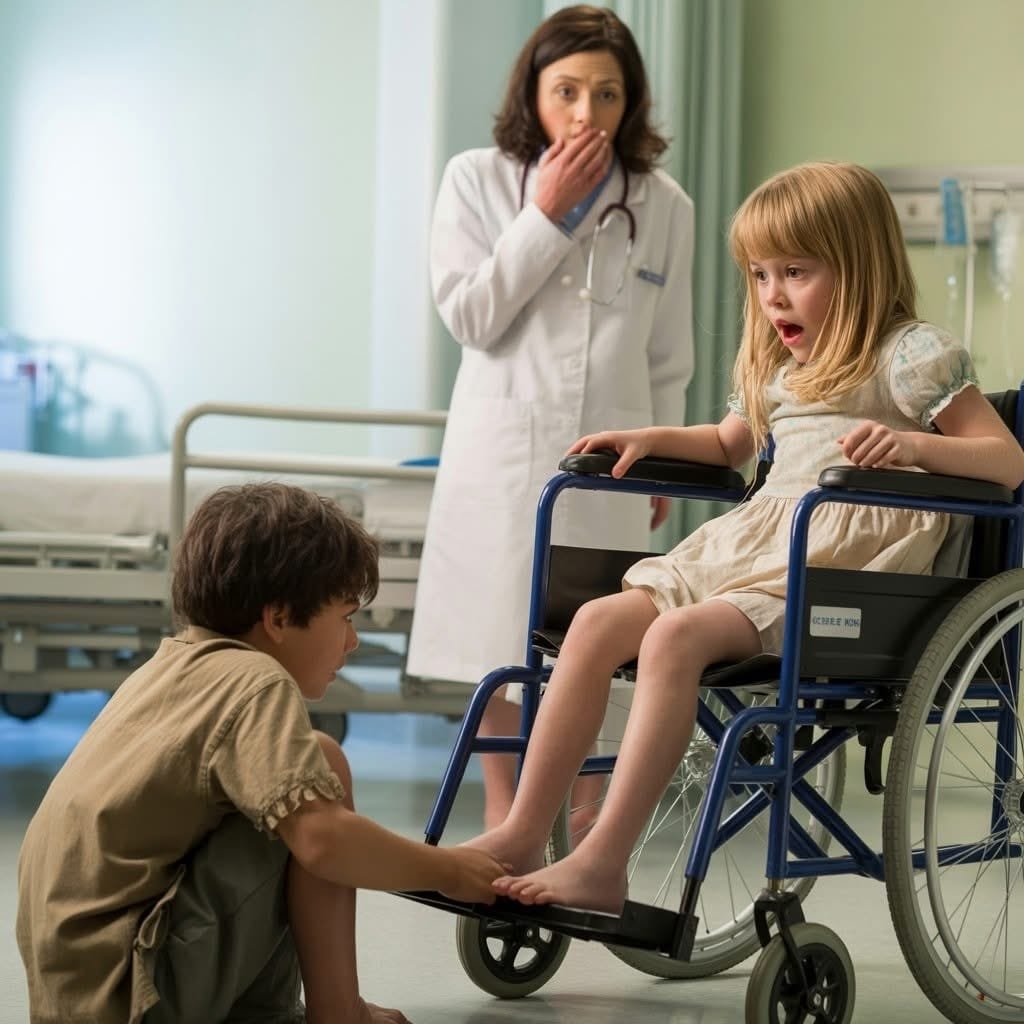
Dr. Eduardo Hernández watched his daughter Valeria through the glass window of the physical therapy room at San Ángel Hospital in Mexico City.
The little blonde girl, two and a half years old, sat motionless in her special wheelchair.
She had never walked.
Not even once.
Every consultation with the best specialists in the country ended with the same discouraging verdict:
“No expectation of spontaneous walking.”
Exhaustion.
Fear.
And slowly fading hope.
As he stared at the glass, Eduardo felt a small tug on his pants.
He looked down and saw a boy of about four years old, with messy brown hair, worn-out clothes, and dirty feet.
— “Doctor… are you the father of the blonde girl?”
Eduardo frowned, confused.
— “Yes. Why?”
— “I can help her. I can make her walk.”
Eduardo almost called security — until the boy added softly:
— “I don’t have parents, doctor. My little sister was like your daughter… before she passed away. I learned how to help her. I learned a lot.”
Valeria, normally apathetic during therapy, suddenly turned her head toward the boy’s voice.
She stretched out her tiny arms.
She smiled.
Her first spontaneous reaction in months.
— FIVE MINUTES THAT CHANGED EVERYTHING
— “What’s your name?” Eduardo asked, kneeling to the boy’s eye level.
— “Mateo. I sleep on the bench in the square across the street. I’ve been watching your daughter through the window every day.”
Before Eduardo could respond, the physiotherapist, Daniela, stepped out of the therapy room:
— “Doctor, the session is over. No response again today.”
Eduardo exhaled.
— “Daniela… this is Mateo. He says he might help Valeria.”
Daniela raised an eyebrow.
— “Doctor, with all due respect, a street child doesn’t have medical knowl—”
— “Just five minutes!” Mateo interrupted.
— “If nothing happens, I’ll leave and never come back.”
Eduardo looked at Valeria.
She was clapping, excited, reaching for Mateo.
That decided it.
— “Five minutes.”
Mateo entered the therapy room calmly, as if he’d done this many times before.
He approached Valeria gently.
— “Hi, princess… want to play with me?”
Valeria stretched out her arms.
Mateo sat on the floor beside her wheelchair and began to sing a soft melody while massaging her small feet.
Eduardo recognized the movements.
— “This looks like reflexology…”
Daniela, stunned, nodded.
Minute by minute, Valeria relaxed.
Her normally stiff legs loosened.
She giggled — a sound Eduardo hadn’t heard in weeks.
— “She’s never reacted like this…” he whispered.
Mateo continued:
— “She likes music. All kids do. My mom said music wakes up the parts of the body that are asleep.”
Then, discreetly, Mateo pulled something from his pocket — a small, old, bent metal spoon.
Eduardo stared.
— “Mateo… what is that?”
The boy smiled.
— “My mom’s. She used it to test my sister’s reflexes.”
He tapped Valeria’s foot lightly with the spoon.
And then it happened:
**Her leg moved. By itself.
Then again.
Then stronger.**
Daniela gasped.
Eduardo froze.
— “My God…”
Valeria giggled and tried to lift her leg — and she did.
Mateo looked up with shining eyes.
— “See, doctor? She just needed someone to talk to her body the right way.”
— THE FIRST STEP
Mateo returned the next day.
And the next.
And the next.
Valeria waited for him every morning.
She responded to every touch, every melody, every exercise.
Within weeks, she could stand using a walker.
But the most emotional moment came two months later.
Mateo entered the room, called Valeria’s name, and opened his arms.
— “Come on, princess… just one step.”
Valeria looked at her father.
Then at Mateo.
And then…
**She took her first step.
Shaky.
Small.
Perfect.**
Eduardo fell to his knees, crying.
Mateo cried too.
Valeria took two more steps — straight into Mateo’s arms.
— “I told you she could do it, doctor…”
Eduardo hugged both children tightly.
— “Mateo… you saved my daughter.”
That night, the surgeon made a decision that would change another life:
**Mateo would never sleep on a bench again.
He would have a home.
A family.
A future.**
Valeria wrapped her arms around Mateo’s neck and whispered her version of his name:
— “Mano Teo.”
Her first way of saying:
“My brother Mateo.”
And so, where medicine failed, a tiny brave heart took the first step toward the impossible.